| Research article |
|

|
|
|
| Root biomechanical properties and influencing factors of two dominant herbs in the landslide area of the upper reaches of the Yellow River, China |
XING Guangyan1,2, HU Xiasong3,4,*( ), LIU Changyi4, ZHAO Jimei2, LU Haijing2, LI Huatan1, LI Guorong4, ZHU Haili4, LIU Yabin4 ), LIU Changyi4, ZHAO Jimei2, LU Haijing2, LI Huatan1, LI Guorong4, ZHU Haili4, LIU Yabin4 |
1School of Civil Engineering and Water Resources, Qinghai University, Xining 810016, China
2Academy of Animal Science and Veterinary, Qinghai University, Xining 810016, China
3State Key Laboratory of Plateau Ecology and Agriculture, Qinghai University, Xining 810016, China
4School of Geological Engineering, Qinghai University, Xining 810016, China |
|
|
|
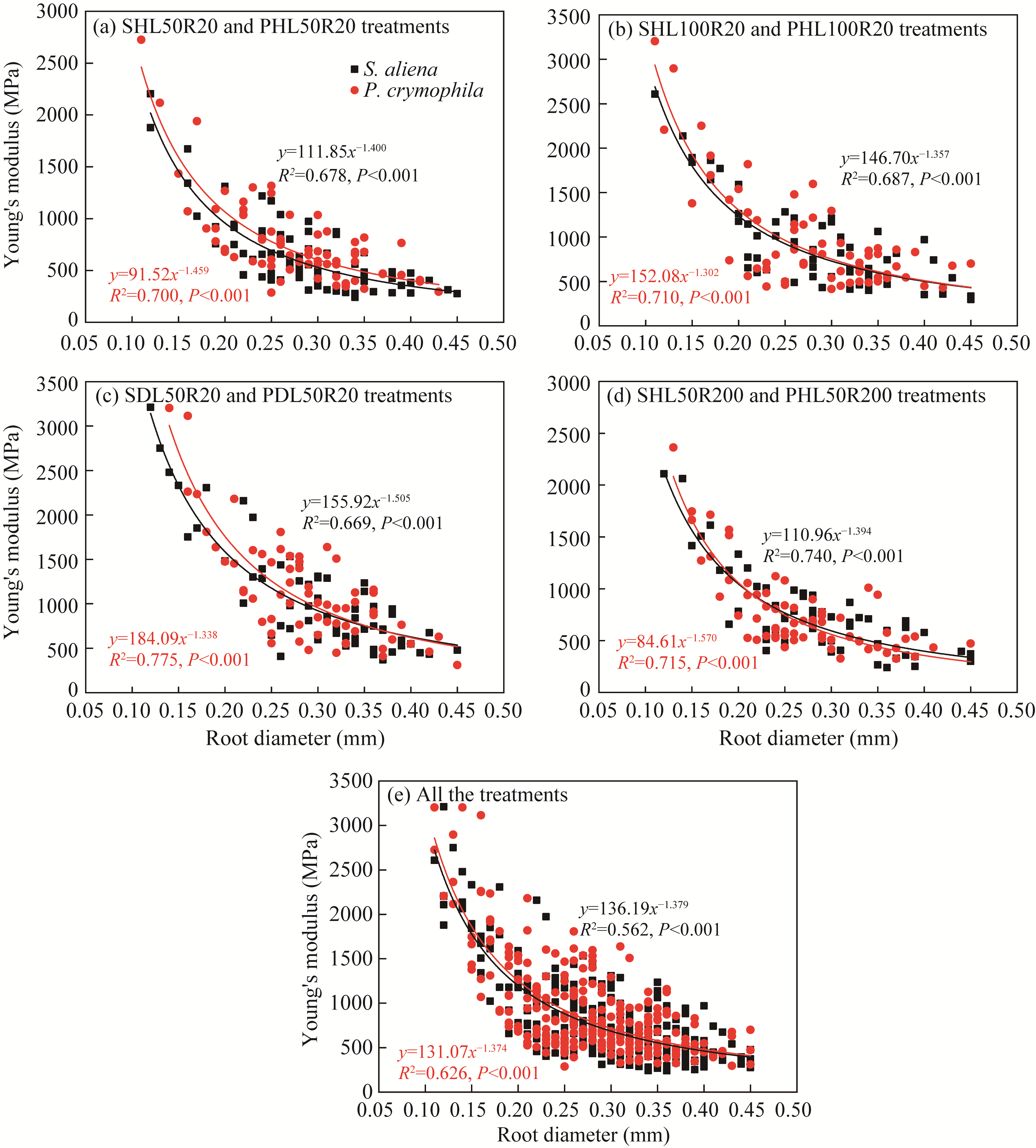
Abstract Soil erosion and shallow landslides in the upper reaches of the Yellow River, China, are increasing due to extreme climate events and human disturbances. The biomechanical properties of vegetation roots play an important role in soil stabilization and fixation, as they resist soil erosion and shallow landslides in this area. However, the biomechanical properties of the roots of dominant herbs and their influencing factors in this area remain poorly understood. Therefore, we selected two dominant herbs in this area, Stipa aliena Keng and Poa crymophila Keng, and carried out a series of uniaxial tensile tests on the roots of the two herbs under different treatments. Meanwhile, the effects of root diameter, plant species, gauge length, root water content, and loading rate on the biomechanical properties of the two herbs' roots were analyzed. The results showed that root diameter was the most significant factor affecting the root biomechanical properties (P<0.010), and root tensile force displayed a positive power law relationship with root diameter, whereas root tensile strength and Young's modulus followed negative power law correlations with root diameter, and fracture strain increased linearly with root diameter. Root tensile force, tensile strength, and fracture strain of S. aliena were significantly greater than those of P. crymophila (P<0.001), which was mainly due to the higher lignin content and lignin:cellulose ratio of S. aliena roots. During uniaxial tensile process, hydrated roots exhibited elastic-plastic-brittle behavior, whereas dried roots exhibited elastic-brittle behavior. Root fracture strain of the two herbs was significantly lower under 100 mm gauge length than under 50 mm gauge length (P<0.001), and the Young's modulus was significantly greater (P<0.050). Tensile strength and fracture strain of hydrated roots of the two herbs were significantly greater than those of dried roots (P<0.050), whereas the Young's modulus was significantly lower (P<0.001). Root tensile force, tensile strength, and fracture strain of S. aliena were significantly greater under 20 mm/min loading rate than under 200 mm/min loading rate (P<0.050), whereas loading rate had no significant effect on the root biomechanical properties of P. crymophila (P>0.050). Fibrous roots of the two herbs were well developed, with relatively high tensile strengths and Young's moduli of 78.498 and 837.901 MPa for S. aliena, and 67.541 and 901.184 MPa for P. crymophila, respectively. The two herbs can stabilize soil and prevent soil erosion and can be used as pioneer species for ecological restoration in the upper reaches of the Yellow River. These results provide a theoretical basis for soil erosion and shallow landslide control in the giant landslide area of the upper reaches of the Yellow River.
|
|
Received: 08 April 2025
Published: 31 December 2025
|
|
Corresponding Authors:
*HU Xiasong (E-mail: huxiasong@sina.com)
|
| Cite this article:
XING Guangyan, HU Xiasong, LIU Changyi, ZHAO Jimei, LU Haijing, LI Huatan, LI Guorong, ZHU Haili, LIU Yabin. Root biomechanical properties and influencing factors of two dominant herbs in the landslide area of the upper reaches of the Yellow River, China. Journal of Arid Land, 2025, 17(12): 1806-1825.
URL:
http://jal.xjegi.com/10.1007/s40333-025-0036-4 OR http://jal.xjegi.com/Y2025/V17/I12/1806
|
|
|
| [1] |
Apriyono A, Yuliana , Kamchoom V, 2023. Serviceability of cut slope and embankment under seasonal climate variations. Acta Geophysica, 71(2): 983-995.
doi: 10.1007/s11600-022-00953-x
|
|
|
| [2] |
Bažant Z P, Kazemi M T. 1990. Size effect in fracture of ceramics and its use to determine fracture energy and effective process zone length. Journal of the American Ceramic Society, 73(7): 1841-1853.
doi: 10.1111/jace.1990.73.issue-7
|
|
|
| [3] |
Boldrin D, Leung A K, Bengough A G. 2018. Effects of root dehydration on biomechanical properties of woody roots of Ulex europaeus. Plant and Soil, 431(1-2): 347-369.
doi: 10.1007/s11104-018-3766-7
|
|
|
| [4] |
Burylo M, Rey F, Bochet E, et al. 2012. Plant functional traits and species ability for sediment retention during concentrated flow erosion. Plant and Soil, 353(1-2): 135-144.
doi: 10.1007/s11104-011-1017-2
|
|
|
| [5] |
Capilleri P P, Cuomo M, Motta E, et al. 2019. Experimental investigation of root tensile strength for slope stabilization. Indian Geotechnical Journal, 49(6): 687-697.
doi: 10.1007/s40098-019-00394-2
|
|
|
| [6] |
Chen X W, Kang Y, So P S, et al. 2018. Arbuscular mycorrhizal fungi increase the proportion of cellulose and hemicellulose in the root stele of vetiver grass. Plant and Soil, 425(1-2): 309-319.
doi: 10.1007/s11104-018-3583-z
|
|
|
| [7] |
Chi N L. 2012. Determination of insoluble carbohydrates in plant fibers. MSc Thesis. Shanghai: Fudan University. (in Chinese)
|
|
|
| [8] |
De Baets S, Poesen J, Reubens B, et al. 2008. Root tensile strength and root distribution of typical Mediterranean plant species and their contribution to soil shear strength. Plant and Soil, 305(1-2): 207-226.
doi: 10.1007/s11104-008-9553-0
|
|
|
| [9] |
Eab K H, Likitlersuang S, Takahashi A. 2015. Laboratory and modelling investigation of root-reinforced system for slope stabilisation. Soils and Foundations, 55(5): 1270-1281.
doi: 10.1016/j.sandf.2015.09.025
|
|
|
| [10] |
Ekeoma E C, Boldrin D, Loades K W, et al. 2021. Drying of fibrous roots strengthens the negative power relation between biomechanical properties and diameter. Plant and Soil, 469(1-2): 321-334.
doi: 10.1007/s11104-021-05150-1
|
|
|
| [11] |
Forster M, Ugarte C, Lamandé M, et al. 2022. Root traits of crop species contributing to soil shear strength. Geoderma, 409: 115642, doi:10.1016/j.geoderma.2021.115642.
|
|
|
| [12] |
Fu J T, Zhao J M, Liu C Y, et al. 2023. Impact of slope position on the distribution and biomechanical properties of roots of dominant herbs. Acta Agrestia Sinica, 31(7): 2020-2030. (in Chinese)
|
|
|
| [13] |
Fu J T, Zhou Z, Guo H, et al. 2024. Biomechanical behavior of grass roots at different gauge lengths. Journal of Mountain Science, 21(9): 3201-3214.
doi: 10.1007/s11629-023-8474-y
|
|
|
| [14] |
Genet M, Stokes A, Salin F, et al. 2005. The influence of cellulose content on tensile strength in tree roots. Plant and Soil, 278(1-2): 1-9.
doi: 10.1007/s11104-005-8768-6
|
|
|
| [15] |
Gray D H, Sotir R. 1996. Biotechnical and Soil Bioengineering Slope Stabilization:A Practical Guide for Erosion Control. New York: Wiley.
|
|
|
| [16] |
Greenwood J R, Norris J E, Wint J. 2004. Assessing the contribution of vegetation to slope stability. Geotechnical Engineering, 157(4): 199-207.
|
|
|
| [17] |
Hales T C, Miniat C F. 2017. Soil moisture causes dynamic adjustments to root reinforcement that reduce slope stability. Earth Surface Processes and Landforms, 42(5): 803-813.
doi: 10.1002/esp.v42.5
|
|
|
| [18] |
Hong-In P, Takahashi A, Likitlersuang S. 2024. Engineering and environmental assessment of soilbag-based slope stabilisation for sustainable landslide mitigation in mountainous area. Journal of Environmental Management, 359: 120970, doi:10.1016/j.jenvman.2024.120970.
|
|
|
| [19] |
Jiang K Y, Chen L H, Gai X G, et al. 2013. Relationship between tensile properties and microstructures of three different broadleaf tree roots in North China. Transactions of the Chinese Society of Agricultural Engineering, 29(3): 115-123. (in Chinese)
|
|
|
| [20] |
Kamchoom V, Leung A K. 2018. Hydro-mechanical reinforcements of live poles to slope stability. Soils and Foundations, 58(6): 1423-1434.
doi: 10.1016/j.sandf.2018.08.003
|
|
|
| [21] |
Lan H X, Peng J B, Zhu Y B, et al. 2022. Geological and surfacial processes and major disaster effects in the Yellow River Basin. Science China Earth Sciences, 52(2): 199-221. (in Chinese)
|
|
|
| [22] |
Leknoi U, Yiengthaisong A, Likitlersuang S. 2025. Promoting use of vetiver grass for landslide protection: A pathway to achieve sustainable development goals in Thailand. Environmental Development, 54: 101155, doi:10.1016/j.envdev.2025.101155.
|
|
|
| [23] |
Li N, Chen L H, Yang Y J. 2015. Factors influencing root tensile properties of Pinus tabuliformis and Larix principis-rupprechti. Journal of Beijing Forestry University, 37(12): 77-84. (in Chinese)
|
|
|
| [24] |
Li Z L. 1987. Plant Production Technology (2nd ed.). Beijing: Science Press. (in Chinese)
|
|
|
| [25] |
Liang T, Bengough A G, Knappett J A, et al. 2017. Scaling of the reinforcement of soil slopes by living plants in a geotechnical centrifuge. Ecological Engineering, 109: 207-227.
doi: 10.1016/j.ecoleng.2017.06.067
|
|
|
| [26] |
Likitlersuang S, Phan T N, Boldrin D, et al. 2022. Influence of growth media on the biomechanical properties of the fibrous roots of two contrasting vetiver grass species. Ecological Engineering, 178: 106574, doi:10.1016/j.ecoleng.2022.106574.
|
|
|
| [27] |
Mao Z, Wang Y, Mccormack M L, et al. 2018. Mechanical traits of fine roots as a function of topology and anatomy. Annals of Botany, 122(7): 1103-1116.
doi: 10.1093/aob/mcy076
pmid: 29846521
|
|
|
| [28] |
Mao Z J, Geng M M. 2023. Study on tensile mechanical properties of alfalfa roots and the influencing factors. Arid Zone Research, 40(2): 235-246. (in Chinese)
doi: 10.13866/j.azr.2023.02.08
|
|
|
| [29] |
Melese D T, Senadheera S, Legas A T. 2021. Effect of diameter, root moisture content, gauge length and loading rate on tensile strength of plant roots and their contribution to slope. Lowland Technology International, 22(4): 164-173.
|
|
|
| [30] |
Moreton R. 1969. The effect of gauge length on the tensile strength of R.A.E. carbon fibres. Fibre Science and Technology, 1(4): 273-284.
doi: 10.1016/0015-0568(69)90012-8
|
|
|
| [31] |
Nguyen T S, Likitlersuang S, Jotisankasa A. 2020. Stability analysis of vegetated residual soil slope in Thailand under rainfall conditions. Environmental Geotechnics, 7(5): 338-349.
doi: 10.1680/jenge.17.00025
|
|
|
| [32] |
Ongpaporn P, Jotisankasa A, Likitlersuang S. 2022. Geotechnical investigation and stability analysis of bio-engineered slope at Surat Thani Province in Southern Thailand. Bulletin of Engineering Geology and the Environment, 81(3): 84, doi:10.1007/s10064-022-02591-5.
|
|
|
| [33] |
Phan T N, Likitlersuang S, Kamchoom V, et al. 2021. Root biomechanical properties of Chrysopogon zizanioides and Chrysopogon nemoralis for soil reinforcement and slope stabilisation. Land Degradation & Development, 32(16): 4624-4636.
doi: 10.1002/ldr.v32.16
|
|
|
| [34] |
Phan T N, Leung A K, Kamchoom V, et al. 2023. Reinforcement losses in soil stabilisation due to decomposing roots of Chrysopogon zizanioides and Chrysopogon nemoralis. Land Degradation & Development, 34(4): 1080-1096.
doi: 10.1002/ldr.v34.4
|
|
|
| [35] |
Pollen N, Simon A. 2005. Estimating the mechanical effects of riparian vegetation on stream bank stability using a fiber bundle model. Water Resources Research, 41(7): 226-244.
|
|
|
| [36] |
Prasetyaningtiyas G A, Kamchoom V, Leung A K, et al. 2024. Hydromechanical behaviour of a slope reinforced by grass roots under rainfall conditions. Ecological Engineering, 209: 107427, doi:10.1016/j.ecoleng.2024.107427.
|
|
|
| [37] |
Saha P, Manna S, Chowdhury S R, et al. 2010. Enhancement of tensile strength of lignocellulosic jute fibers by alkali-steam treatment. Bioresource Technology, 101(9): 3182-3187.
doi: 10.1016/j.biortech.2009.12.010
pmid: 20074944
|
|
|
| [38] |
Schwarz M, Preti F, Giadrossich F, et al. 2010. Quantifying the role of vegetation in slope stability: A case study in Tuscany (Italy). Ecological Engineering, 36(3): 285-291.
doi: 10.1016/j.ecoleng.2009.06.014
|
|
|
| [39] |
Shi Z H, Wang L, Liu Q J, et al. 2018. Soil erosion: From comprehensive control to ecological regulation. Bulletin of Chinese Academy of Sciences, 33(2): 198-205. (in Chinese)
|
|
|
| [40] |
Stokes A, Douglas G B, Fourcaud T, et al. 2014. Ecological mitigation of hillslope instability: Ten key issues facing researchers and practitioners. Plant and Soil, 377(1-2): 1-23.
doi: 10.1007/s11104-014-2044-6
|
|
|
| [41] |
Tiimonen H. 2007. Lignin characteristics and ecological interactions of PtCOMT-modified silver birch. PhD Dissertation. Finland: University of Oulu.
|
|
|
| [42] |
Waldron L J. 1977. The shear resistance of root-permeated homogeneous and stratified soil. Soil Science Society of America Journal, 41(5): 843-848.
doi: 10.2136/sssaj1977.03615995004100050005x
|
|
|
| [43] |
Waldron L J, Dakessian S. 1981. Soil reinforcement by roots: Calculation of increased soil shear resistance from root properties. Soil Science, 132(6): 427-435.
doi: 10.1097/00010694-198112000-00007
|
|
|
| [44] |
Wang X, Hong M M, Huang Z, et al. 2019. Biomechanical properties of plant root systems and their ability to stabilize slopes in geohazard-prone regions. Soil and Tillage Research, 189: 148-157.
doi: 10.1016/j.still.2019.02.003
|
|
|
| [45] |
Wu T H. 1976. Investigation of landslides on Prince of Wales Island. Columbus: Ohio State University.
|
|
|
| [46] |
Wu T H, Mckinnell III W P, Swanston D N. 1979. Strength of tree roots and landslides on Prince of Wales Island, Alaska. Canadian Geotechnical Journal, 16(1): 19-33.
doi: 10.1139/t79-003
|
|
|
| [47] |
Wu Z, Leung A K, Boldrin D, et al. 2021. Variability in root biomechanics of Chrysopogon zizanioides for soil eco-engineering solutions. Science of the Total Environment, 776: 145943, doi:10.1016/j.scitotenv.2021.145943.
|
|
|
| [48] |
Yang Y J, Chen L H, Li N, et al. 2016a. Effect of root moisture content and diameter on root tensile properties. PLoS ONE, 11(3): e0151791, doi:10.1371/journal.pone.0151791.
|
|
|
| [49] |
Yang Y J, Chen L H, Li N. 2016b. How gauge length and loading rate influence the root tensile strength of Betula platyphylla. Journal of Soil and Water Conservation, 71(6): 460-466. (in Chinese)
doi: 10.2489/jswc.71.6.460
|
|
|
| [50] |
Yang Y Z, Yang J H, Ji J N, et al. 2025. How do stele and pores affect the macro-biomechanical properties of plant roots in tension?. Plant and Soil, 514(1): 919-935.
doi: 10.1007/s11104-025-07426-2
|
|
|
| [51] |
Ye C, Guo Z L, Cai C F, et al. 2017. Relationship between root tensile mechanical properties and main chemical components of five herbaceous species. Pratacultural Science, 34(3): 598-606. (in Chinese)
|
|
|
| [52] |
Zhang C B, Chen L H, Jiang J, et al. 2012. Effects of gauge length and strain rate on the tensile strength of tree roots. Trees, 26(5): 1577-1584.
doi: 10.1007/s00468-012-0732-5
|
|
|
| [53] |
Zhang C B, Chen L H, Jiang J. 2014. Why fine tree roots are stronger than thicker roots: The role of cellulose and lignin in relation to slope stability. Geomorphology, 206: 196-202.
doi: 10.1016/j.geomorph.2013.09.024
|
|
|
| [54] |
Zhang C B, Zhou X, Jiang J, et al. 2019. Root moisture content influence on root tensile tests of herbaceous plants. CATENA, 172: 140-147.
doi: 10.1016/j.catena.2018.08.012
|
|
|
| [55] |
Zhang C B, Ma X, Liu Y, et al. 2021. Influence of various gauge lengths, root spacing and root numbers on root tensile properties of herbaceous plants. Sains Malaysiana, 50(9): 2499-2510.
doi: 10.17576/jsm
|
|
|
| [56] |
Zhang C B, Li R, Jiang J, et al. 2023. Effects of loading rate on root pullout performance of two plants in the eastern Loess Plateau, China. Journal of Arid Land, 15(9): 1129-1142.
doi: 10.1007/s40333-023-0026-3
|
|
|
| [57] |
Zhang L, Xia Z Y, Zhou Z J, et al. 2018. Experimental study on tensile properties and reinforcement ability of plant roots. Nature Environment and Pollution Technology, 17(3): 729-738.
|
|
|
| [58] |
Zhang Y, Zhu H L, Zhang K, et al. 2022. Relationship between tensile properties and microstructure of single root of three riparian plants. Arid Zone Research, 39(2): 572-583. (in Chinese)
doi: 10.13866/j.azr.2022.02.24
|
|
|
| [59] |
Zhao J M, Hu X S, Fu J T, et al. 2024. Vegetation distribution pattern and their root mechanical property characteristics of giant landslide in the upper reaches of the Yellow River. Acta Prataculturae Sinica, 33(1): 33-49. (in Chinese)
|
|
|
| [60] |
Zhao L B, Zhang B G. 2007. Experimental study on root bio-mechanics and relevant factors of Medicago sativa and Digitaria sanguinalis. Transactions of the Chinese Society of Agricultural Engineering, 23(9): 7-12. (in Chinese)
|
|
|
| [61] |
Zhu J Q, Wang Y Q, Wang Y J, et al. 2020. How does root biodegradation after plant felling change root reinforcement to soil?. Plant and Soil, 446(1-2): 211-227.
doi: 10.1007/s11104-019-04345-x
|
|
|
|
Viewed |
|
|
|
Full text
|
|
|
|
|
Abstract
|
|
|
|
|
Cited |
|
|
|
|
| |
Shared |
|
|
|
|
| |
Discussed |
|
|
|
|