| Research article |
|


|
|
|
| Provenance of the iron hypothesis: Guidance from multiproxy analysis of surface sediments at the southern margin of the Taklimakan Desert, China |
MA Xueyang1,*( ), GUO Benhong2, ZHANG Xiaonan3, ZHANG Yuzhi4 ), GUO Benhong2, ZHANG Xiaonan3, ZHANG Yuzhi4 |
1 College of Environmental Science and Engineering, China West Normal University, Nanchong 637009, China
2 School of Earth Sciences, Lanzhou University, Lanzhou 730000, China
3 Yunnan Key Laboratory of Ecological Protection and Resource Utilization of River-Lake Networks, Institute for Ecological Research and Pollution Control of Plateau Lakes, School of Ecology and Environmental Science, Yunnan University, Kunming 650500, China
4 College of Resources and Environment, Shanxi University of Finance and Economics, Taiyuan 030006, China |
|
|
|
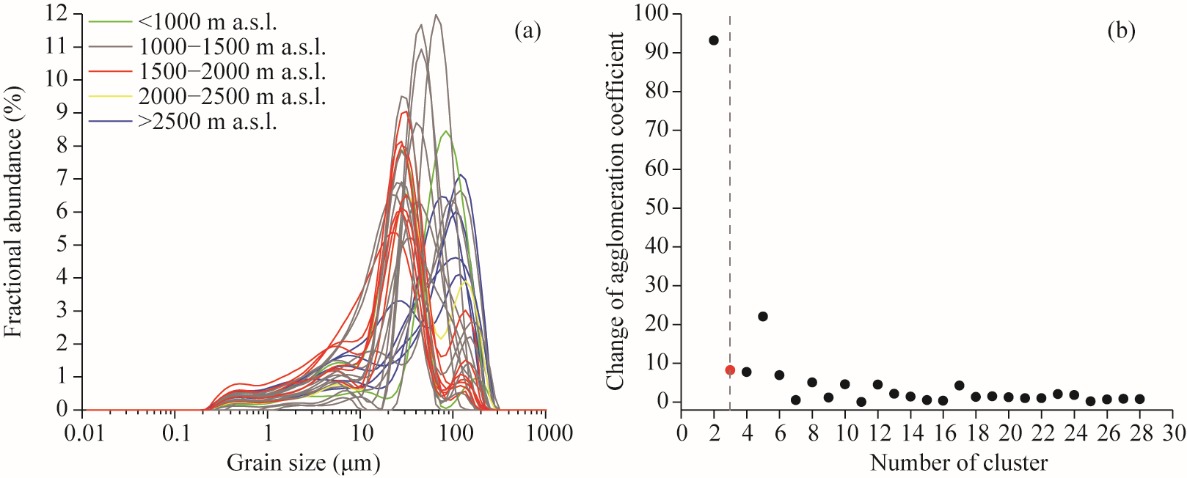
Abstract The Taklimakan Desert plays an important role in understanding the provenance of the iron hypothesis, which posits that iron availability limits phytoplankton growth in oceans. However, the modern processes governing iron provenance in mountain-desert transition areas remain largely unknown. To address this issue, this study systematically sampled surface sediments along an east-west transect in the Kunlun-Altun piedmont, and analyzed their grain sizes, magnetic susceptibility, total organic carbon (TOC) content, total nitrogen (TN) content, X-ray diffraction (XRD) spectra, and major elements. The grain size distributions (GSDs) at low (<2000 m a.s.l.) and high (>2000 m a.s.l.) altitudes suggested that surface sediments originated from the Kunlun-Altun Mountains, and each exhibited distinct sediment reworking and transport histories. Low chemical index of alteration (CIA) values (<65.00) confirmed that physical weathering was the predominant process and that limited chemical alteration occurred, with the preservation of provenance signatures from the Kunlun-Altun lithologies. Therefore, in the surface sediments, weakly magnetic ferrous ion (Fe2+)-bearing biotite served as the primary iron source. Aeolian transport (relatively fine component), TOC, and the normalized difference vegetation index (NDVI) served as key constraints on iron source dynamics. This study revealed the mineralogical form and influencing constraints of iron sources in the surface sediments derived from the northern Qinghai-Xizang Plateau, providing insights for distinguishing iron sources of the iron hypothesis in paleoclimate proxies.
|
|
Received: 20 December 2025
Published: 31 May 2026
|
|
Corresponding Authors:
*MA Xueyang (E-mail: xyma2018@cwnu.edu.cn)
|
| About author: Author contributions
Conceptualization: MA Xueyang, GUO Benhong; Data curation: MA Xueyang, ZHANG Xiaonan; Formal analysis: MA Xueyang, ZHANG Xiaonan; Funding acquisition: MA Xueyang, GUO Benhong, ZHANG Xiaonan, ZHANG Yizhi; Investigation: MA Xueyang; Methodology: MA Xueyang, GUO Benhong, ZHANG Xiaonan; Project administration: MA Xueyang; Resources: MA Xueyang, ZHANG Xiaonan; Software: MA Xueyang, ZHANG Xiaonan; Supervision: MA Xueyang, GUO Benhong; Validation: MA Xueyang; Visualization: MA Xueyang; Writing - original draft preparation: MA Xueyang; Writing - review and editing: MA Xueyang, GUO Benhong. All authors approved the manuscript.
|
|
|
| [1] |
Boyd P W, Jickells T, Law C S, et al. 2007. Mesoscale iron enrichment experiments 1993-2005: Synthesis and future directions. Science, 315(5812): 612-617.
pmid: 17272712
|
|
|
| [2] |
Chang Q, Mishima T, Yabuki S, et al. 2000. Sr and Nd isotope ratios and REE abundances of moraines in the mountain areas surrounding the Taklimakan Desert, NW China. Geochemical Journal, 34(6): 407-427.
|
|
|
| [3] |
Chen Q J, Li Z L, Dong S P, et al. 2021. Applicability of chemical weathering indices of eolian sands from the deserts in northern China. CATENA, 198: 105032, doi: 10.1016/j.catena.2020.105032.
|
|
|
| [4] |
Chen X L, Song Y G, Li Y, et al. 2020. Provenance of sub-aerial surface sediments in the Tarim Basin, western China. CATENA, 198: 105014, doi: 10.1016/j.catena.2020.105014.
|
|
|
| [5] |
Chen Z X, Lü B, Zheng X F, et al. 2019. Topsoil magnetic properties and its environmental significance in West Sichuan. Acta Pedologica Sinica, 56(3): 661-671. (in Chinese)
|
|
|
| [6] |
Chisholm S W. 1995. The iron hypothesis: Basic research meets environmental policy. Reviews of Geophysics, 33(S2): 1277-1286.
doi: 10.1029/95RG00743
|
|
|
| [7] |
Deng K, Yang S Y, Guo Y L. 2022. A global temperature control of silicate weathering intensity. Nature Communications, 13(1): 1781, doi: 10.1038/s41467-022-29415-0.
|
|
|
| [8] |
Dietze E, Hartmann K, Diekmann B, et al. 2012. An end-member algorithm for deciphering modern detrital processes from lake sediments of Lake Donggi Cona, NE Tibetan Plateau, China. Sedimentary Geology, 243-244: 169-180.
doi: 10.1016/j.sedgeo.2011.09.014
|
|
|
| [9] |
Fedo C M, Nesbitt H W, Young G M. 1995. Unraveling the effects of potassium metasomatism in sedimentary rocks and paleosols, with implications for paleoweathering conditions and provenance. Geology, 23(10): 921-924.
doi: 10.1130/0091-7613(1995)023<0921:UTEOPM>2.3.CO;2
|
|
|
| [10] |
Feng L J, Chu X L, Zhang Q R, et al. 2003. CIA (Chemical Index of Alteration) and its applications in the Neoproterozoic clastic rocks. Earth Science Frontiers, 10(4): 539-544. (in Chinese)
|
|
|
| [11] |
Fu H J, Jian X, Liang H H. 2021. Research progress of sediment indicators and methods for evaluation of silicate chemical weathering intensity. Journal of Palaeogeography, 23(6): 1192-1209. (in Chinese)
|
|
|
| [12] |
Gao H, Washington R. 2009. The spatial and temporal characteristics of TOMS AI over the Tarim Basin, China. Atmospheric Environment, 43(5): 1106-1115.
doi: 10.1016/j.atmosenv.2008.11.013
|
|
|
| [13] |
Groffman P M, Eagan P, Sullivan W M, et al. 1996. Grass species and soil type effects on microbial biomass and activity. Plant and Soil, 183(1): 61-67.
doi: 10.1007/BF02185565
|
|
|
| [14] |
Hattori Y, Suzuki K, Honda M, et al. 2003. Re-os isotope systematics of the Taklimakan Desert sands, moraines and river sediments around the Taklimakan Desert, and of Tibetan soils. Geochimica et Cosmochimica Acta, 67(6): 1203-1213.
doi: 10.1016/S0016-7037(02)01206-1
|
|
|
| [15] |
He T, Sun Y B, Gray J, et al. 2021. Provenance of Fe in Chinese deserts: Evidence from the geochemistry and mineralogy of soil particles. CATENA, 198: 105053, doi: 10.1016/j.catena.2020.105053.
|
|
|
| [16] |
He X, Yang X Y, Leng M R, et al. 2025. Comparative Analysis of mineral quantification methods in lake sediments: Application assessment of Rietveld and RIR methods. Journal of Salt Lake Research, 33(5): 87-95. (in Chinese)
|
|
|
| [17] |
Huang J, Wu G J, Zhao H B, et al. 2024. Quantifying the contribution of multiple processes to the dust decreasing trend in the Guliya Ice Core over the past 50 years. Geophysical Research Letters, 51(17): e2024GL110429, doi: 10.1029/2024GL110429.
|
|
|
| [18] |
Iwashita A, Nakajima T, Takanashi H, et al. 2006. Effect of pretreatment conditions on the determination of major and trace elements in coal fly ash using ICP-AES. Fuel, 85(2): 257-263.
doi: 10.1016/j.fuel.2005.04.034
|
|
|
| [19] |
Jiang Q D, Yang X P. 2019. Sedimentological and geochemical composition of aeolian sediments in the Taklamakan Desert: Implications for provenance and sediment supply mechanisms. Journal of Geophysical Research-Earth Surface, 124(5): 1217-1237.
doi: 10.1029/2018JF004990
|
|
|
| [20] |
Joshani A, Mirzaei Y, Barber A, et al. 2024. Organic matter preservation through complexation with iron minerals in two basins of a dimictic boreal lake with contrasting deep water redox regimes. Science of The Total Environment, 925: 171776, doi: 10.2139/ssrn.4632067.
|
|
|
| [21] |
Ju C Q, Niu D F, Li B S, et al. 2019. Reticulate laterite constant element distribution and its significance in MIS 5a, Xiqiaoshan, Guangdong Province. Quaternary Sciences, 39(5): 1083-1091. (in Chinese)
|
|
|
| [22] |
Li H L, Gao X, Zhao Y C, et al. 2025. A comprehensive grain-size database of surface sediments from the Taklamakan Desert. Scientific Data, 12: 585, doi: 10.1038/s41597-025-04936-7.
|
|
|
| [23] |
Lipp A, Shorttle O, Syvre F, et al. 2020. Major element composition of sediments in terms of weathering and provenance: implications for crustal recycling. Geochemistry, Geophysics, Geosystems, 21(6): e2019GC00875, doi: 10.1029/2019GC008758.
|
|
|
| [24] |
Liu Q S, Roberts A P, Larrasoaña J C, et al. 2012. Environmental magnetism: Principles and applications. Reviews of Geophysics, 50(4): RG4002, doi: 10.1029/2012RG000393.
|
|
|
| [25] |
Liu X, Yang J H, Zhao L, et al. 2024. Aeolian activity in the Yarlung Zangbo River Basin, southern Tibetan Plateau, began at 584 ka: implications for the glaciation of the Tibetan Plateau. Quaternary Science Reviews, 337: 108799, doi: 10.1016/j.quascirev.2024.108799.
|
|
|
| [26] |
Liu Y X, Xiao Y T, Cui L H, et al. 2025. Tracing the contribution of dust origins on deposition and phytoplankton carbon uptake in global oceans. Biogeosciences, 22(21): 6445-6464.
doi: 10.5194/bg-22-6445-2025
|
|
|
| [27] |
Liu Z Y, Dong Z B, Zhang Z C, et al. 2019. Spatial and temporal variation of the near-surface wind regimes in the Taklimakan Desert, Northwest China. Theoretical and Applied Climatology, 138(1-2): 433-447.
doi: 10.1007/s00704-019-02824-w
|
|
|
| [28] |
Lu H Y, Miao X D, Sun Y B. 2002. Pretreatment methods and their influences on grain-size measurement of aeolian red clay in North China. Marine Geology & Quaternary Geology, 22(3): 129-135. (in Chinese)
|
|
|
| [29] |
Lu W Y, Zhao W C, Balsam W, et al. 2017. Iron mineralogy and speciation in clay-sized fractions of Chinese desert sediments. Journal of Geophysical Research: Atmospheres, 122(24): 13458-13471.
|
|
|
| [30] |
Lupker M, France-Lanord C, Galy V, et al. 2012. Predominant floodplain over mountain weathering of Himalayan sediments (Ganga Basin). Geochimica et Cosmochimica Acta, 84: 410-432.
doi: 10.1016/j.gca.2012.02.001
|
|
|
| [31] |
Ma L F, Qiao X, Min L, et al. 2002. Altas of Chinese Geology. Beijing: Geological Publishing House, 109-111. (in Chinese)
|
|
|
| [32] |
McLennan S M. 1993. Weathering and global denudation. Journal of Geology, 101(2): 295-303.
doi: 10.1086/648222
|
|
|
| [33] |
Nesbitt H W, Young G M. 1982. Early Proterozoic climates and plate motions inferred from major element chemistry of lutites. Nature, 299(21): 715-717.
doi: 10.1038/299715a0
|
|
|
| [34] |
Nie J S, King J W, Fang X M. 2007. Enhancement mechanisms of magnetic susceptibility in the Chinese red-clay sequence. Geophysical Research Letters, 34(19): L19705, doi: 10.1029/2007GL031430.
|
|
|
| [35] |
Nosrati K, Collins A L, Madankan M. 2018. Fingerprinting sub-basin spatial sediment sources using different multivariate statistical techniques and the Modified MixSIR model. CATENA, 164: 32-43.
doi: 10.1016/j.catena.2018.01.003
|
|
|
| [36] |
Ohta T, Arai H. 2007. Statistical empirical index of chemical weathering in igneous rocks: A new tool for evaluating the degree of weathering. Chemical Geology, 240(3-4): 280-297.
doi: 10.1016/j.chemgeo.2007.02.017
|
|
|
| [37] |
Okin G S. 2013. Linked Aeolian-Vegetation Systems. San Diego: Academic Press, 428-439.
|
|
|
| [38] |
Pan F, Li J X, Nie J S, et al. 2023. Provenance of eolian deposits in the Xorkol Basin: Implications for Eocene dust-transport pattern in western China. Geological Society of America Bulletin, 135(9-10): 2554-2562.
|
|
|
| [39] |
Paterson G A, Heslop D. 2015. New methods for unmixing sediment grain size data. Geochemistry, Geophysics, Geosystems, 16(12): 4494-4506.
doi: 10.1002/ggge.v16.12
|
|
|
| [40] |
Perri F, Critelli S, Martín-Algarra A, et al. 2013. Triassic redbeds in the Malaguide Complex (Betic Cordillera—Spain): Petrography, geochemistry and geodynamic implications. Earth-Science Reviews, 117: 1-28.
doi: 10.1016/j.earscirev.2012.11.002
|
|
|
| [41] |
Rao W B, Tan H B, Chen J, et al. 2015. Nd-Sr isotope geochemistry of fine-grained sands in the basin-type deserts, West China: Implications for the source mechanism and atmospheric transport. Geomorphology, 246: 458-471.
doi: 10.1016/j.geomorph.2015.06.043
|
|
|
| [42] |
Rittner M, Vermeesch P, Carter A, et al. 2016. The provenance of Taklamakan Desert sand. Earth and Planetary Science Letters, 437: 127-137.
doi: 10.1016/j.epsl.2015.12.036
|
|
|
| [43] |
Sawyer E W. 1986. The influence of source rock type, chemical weathering and sorting on the geochemistry of clastic sediments from the Quetico Metasedimentary Belt, Superior Province, Canada. Chemical Geology, 55(1-2): 77-95.
doi: 10.1016/0009-2541(86)90129-4
|
|
|
| [44] |
Shao Y P, Wyrwoll K, Chappell A, et al. 2011. Dust cycle: An emerging core theme in Earth system science. Aeolian Research, 2(4): 181-204.
doi: 10.1016/j.aeolia.2011.02.001
|
|
|
| [45] |
Shoenfelt E M, Winckler G, Annett A L, et al. 2019. Physical weathering intensity controls bioavailable primary iron(II) silicate content in major global dust sources. Geophysical Research Letters, 46(19): 10854-10864.
doi: 10.1029/2019GL084180
|
|
|
| [46] |
Song Y, Hao Q Z, Ge J Y, et al. 2012. Quantitative relationships between modern soil magnetic susceptibility and climatic variables of the Chinese Loess Plateau. Quaternary Sciences, 32(4): 679-689. (in Chinese)
|
|
|
| [47] |
Song Y G, Chen X L, Li Y, et al. 2022. Quantifying the provenance of dune sediments in the Taklimakan Desert using machine learning, multidimensional scaling and sediment source fingerprinting. CATENA, 210: 105902, doi: 10.1016/j.catena.2021.105902.
|
|
|
| [48] |
Stoll H. 2020. 30 years of the iron hypothesis of ice ages. Nature, 578(7795): 370-371.
doi: 10.1038/d41586-020-00393-x
|
|
|
| [49] |
Sun J M. 2002. Provenance of loess material and formation of loess deposits on the Chinese Loess Plateau. Earth and Planetary Science, 203(3-4): 845-859.
|
|
|
| [50] |
Taylor S R, McLennan S M. 1985. The Continental Crust: Its Composition and Evolution. Oxford: Blackwells Scientific Publications, 201-215.
|
|
|
| [51] |
Taylor S R, McLennan S M. 2008. Planetary Crusts: Their Composition, Origin and Evolution. Cambridge: Cambridge University Press, 301-324.
|
|
|
| [52] |
Wang C S, Zhao X X, Liu Z F, et al. 2008. Constraints on the early uplift history of the Tibetan Plateau. Proceedings of the National Academy of Sciences of the United States of America, 105(13): 4987-4992.
|
|
|
| [53] |
Wang C S, Dai J G, Zhao X X, et al. 2014. Outward-growth of the Tibetan Plateau during the Cenozoic: A review. Tectonophysics, 621: 1-43.
doi: 10.1016/j.tecto.2014.01.036
|
|
|
| [54] |
Wang J G. 2017. Biogeochemistry:Material Circulation and Soil Processes. Beijing: China Agricultural University Press, 306-336. (in Chinese)
|
|
|
| [55] |
Weltje G J, Prins M A. 2007. Genetically meaningful decomposition of grain-size distributions. Sedimentary Geology, 202(3): 409-424.
doi: 10.1016/j.sedgeo.2007.03.007
|
|
|
| [56] |
Williams M. 2014. Climate Change in Deserts: Past, Present and Future. London: Cambridge University Press, 360-383.
|
|
|
| [57] |
Yan L B, Meng Q T, Zhou Y, et al. 2024. Variations of summer precipitation in Tarim Basin and their linkages with the westerly, Asian monsoons and extratropical circulation. Theoretical and Applied Climatology, 155: 7679-7689.
doi: 10.1007/s00704-024-05098-z
|
|
|
| [58] |
Yang J L, Chen S Q, Ling Z Y, et al. 2025. Spatiotemporal evolution of aeolian sedimentary landscapes on the southern Tibetan Plateau during the late Quaternary: A review and recent advances. Earth-Science Reviews, 261: 105035, doi: 10.1016/j.earscirev.2024.105035.
|
|
|
| [59] |
Ye Z X, Chen Y N, Zhang X. 2014. Dynamics of runoff, river sediments and climate change in the upper reaches of the Tarim River, China. Quaternary International, 336: 13-19.
doi: 10.1016/j.quaint.2013.06.006
|
|
|
| [60] |
Yu S Y, Colman S M, Li L X. 2015. BEMMA: A hierarchical Bayesian end-member modeling analysis of sediment grain-size distributions. Mathematical Geosciences, 48: 723-741.
doi: 10.1007/s11004-015-9611-0
|
|
|
| [61] |
Yumimoto K, Eguchi K, Uno I, et al. 2009. An elevated large-scale dust veil from the Taklimakan Desert: Intercontinental transport and three-dimensional structure as captured by CALIPSO and regional and global models. Atmospheric Chemistry and Physics, 9(21): 8545-8558.
|
|
|
| [62] |
Zan J B, Fang X M, Nie J S, et al. 2011. Magnetic properties of surface soils across the southern Tarim Basin and their relationship with climate and source materials. Chinese Science Bulletin, 56(3): 290-296.
doi: 10.1007/s11434-010-4210-4
|
|
|
| [63] |
Zan J B, Maher B A, Yamazaki T, et al. 2023. Mid-Pleistocene links between Asian dust, Tibetan glaciers, and Pacific iron fertilization. Proceedings of the National Academy of Sciences of the United States of America, 120(24): e2304773120, doi: 10.1073/pnas.2304773120.
|
|
|
| [64] |
Zan J B, Fang X M, Ning W X, et al. 2024. The dynamic links between Central Asian dust emission, Tibetan cryosphere, Pacific productivity and global climate changes. Chinese Science Bulletin, 69(32): 4704-4715. (in Chinese)
|
|
|
| [65] |
Zan J B, Maher B A, Fang X M, et al. 2025. Global dust impacts on biogeochemical cycles and climate. Nature Reviews Earth & Environment, 6: 789-807.
|
|
|
| [66] |
Zhang W F, Wu J L, Zhan S E, et al. 2023. Spatial trace and rare earth elemental compositions of surficial sediments on the high mountains, Central Asia, and implications for desert sand and Asian dust. CATENA, 233: 107515, doi: 10.1016/j.catena.2023.107515.
|
|
|
| [67] |
Zhang X N, Zhou A F, Wang X, et al. 2017. Unmixing grain-size distributions in lake sediments: a new method of endmember modeling using hierarchical clustering. Quaternary Research, 89(1): 365-373.
doi: 10.1017/qua.2017.78
|
|
|
| [68] |
Zhu B Q, Yu J J, Qin X G, et al. 2013. Fromation and evolution of sandy deserts in Xinjiang: the palaeo-environmental evidences. Acta Geographica Sinica, 68(5): 661-679. (in Chinese)
|
|
|
|
Viewed |
|
|
|
Full text
|
|
|
|
|
Abstract
|
|
|
|
|
Cited |
|
|
|
|
| |
Shared |
|
|
|
|
| |
Discussed |
|
|
|
|