| Research article |
|


|
|
|
| Prior-year climate and fuel availability shape fire occurrence in the semi-arid woody lands of Argentina |
Laura B RODRÍGUEZ1,2, Silvia S TORRES-ROBLES1,*( ), Néstor I GASPARRI2,3 ), Néstor I GASPARRI2,3 |
1 National University of Río Negro, Atlantic Headquarters, Center for Environmental Studies from Norpatagonia (CEANPa), Viedma 8500, Argentina
2 National Council of Scientific and Technical Research (CONICET), Godoy Cruz 2290, Argentina
3 Institute of Regional Ecology (IER)-CONICET, Faculty of Natural Sciences and Miguel Lillo Institute, National University of Tucumán (UNT), Yerba Buena 4107, Argentina |
|
|
|
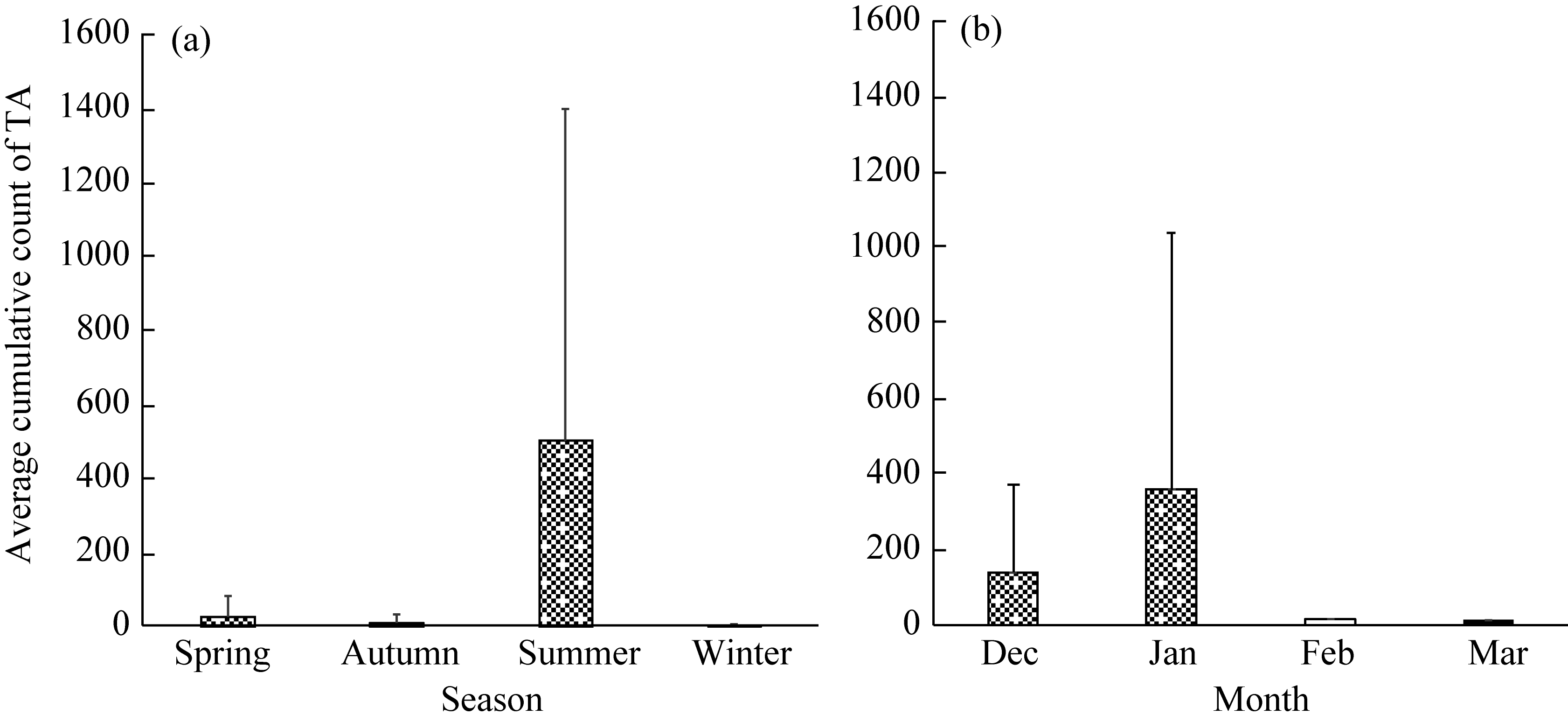
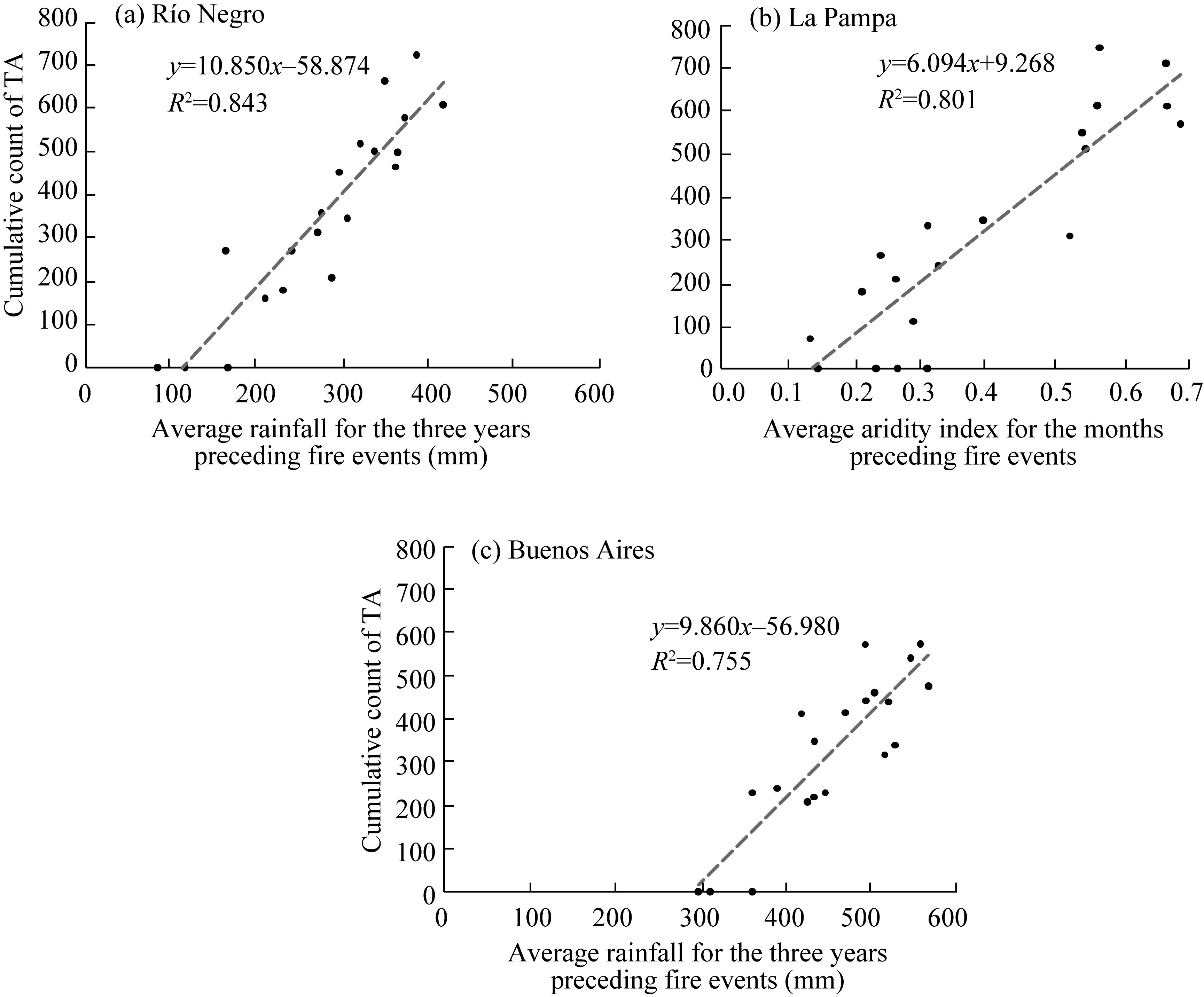
Abstract Fire is a fundamental ecological driver shaping natural vegetation patterns. In the semi-arid southern Espinal-Monte ecotone of Argentina, the spatiotemporal patterns of fire occurrence related to and modulated by climatic gradients and antecedent conditions are not well researched. This study examined fire occurrence in the semi-arid southern Espinal-Monte ecotone (southeastern La Pampa, northeastern Río Negro, and southwestern Buenos Aires with an area of 68×103 km2) of Argentina, a key environmental transition zone with pronounced climatic and vegetation gradients. The objective was to identify the spatiotemporal patterns of fire occurrence and their relationship with climatic variables. Thermal anomaly (TA) data from the MODIS (Moderate Resolution Imaging Spectrometer; MOD14) sensor (November 2000-March 2020) with confidence levels >65.0% were analyzed. Climatic variables (rainfall isohyets and aridity indices) were obtained from the WorldClim datasets, and annual meteorological conditions (rainfall and potential evapotranspiration) were calculated using the climatic research unit (CRU) database. Monthly data and moving averages of rainfall and aridity indices from distinct periods (two and three years preceding fire events) were integrated. Spatial analysis was conducted using kernel density estimation on a 10 km×10 km grid to correlate TA with climatic gradients, while linear regression examined relationships between summer TA and meteorological variables over different periods. Results showed that the highest fire occurrence was recorded in summer, with peaks in December and January. Spatially, 55.0% of TA occurred in areas with annual rainfall of 300-400 mm, and 64.5% in areas with an aridity index of 0.3-0.4, forming an arc-like distribution in the center of the ecotone. The highest TA densities were observed in southeastern La Pampa and northeastern Río Negro, decreasing toward southwestern Buenos Aires. Significant correlations (R2>0.700) were found among TA accumulation, aridity index values, and cumulative rainfall from previous two and three years, at both vegetation unit and provincial levels. Summer was the critical season for fire occurrence, with spatial distribution primarily determined by the interaction between climatic conditions and woody biomass availability. The lower fire incidence in southwestern Buenos Aires was linked to sparse woody vegetation and agricultural expansion, which reduced fuel load. These findings reinforce that fuel availability, modulated by climatic conditions from previous years, is a key limiting factor for fire dynamics in this area, and that human activities such as agriculture and grazing alter fire regimes by affecting fuel structure and continuity.
|
|
Received: 21 June 2025
Published: 28 February 2026
|
|
Corresponding Authors:
*Silvia S TORRES-ROBLES (E-mail: storresr@unrn.edu.ar)
|
|
|
| [1] |
Aráoz E, Grau H R. 2010. Fire-mediated forest encroachment in response to climatic and land-use change in subtropical Andean tree lines. Ecosystems, 13: 992-1005.
doi: 10.1007/s10021-010-9369-7
|
|
|
| [2] |
Argañaraz J P, Gavier-Pizarro G, Zak M, et al. 2015. Fire regime, climate, and vegetation in the Sierras de Córdoba, Argentina. Fire Ecology, 11(1): 55-73.
doi: 10.4996/fireecology.1101055
|
|
|
| [3] |
Bohn V, Piccolo C, Perillo G. 2011. Analysis of dry and wet periods in southwestern Buenos Aires Province (Argentina). Journal of Climatology, 11: 31-43. (in Spanish)
|
|
|
| [4] |
Bran D E, Cecchi G A, Gaitán J J, et al. 2007. Effect of burn severity on vegetation regeneration in the Southern Monte. Austral Ecology (Argentina), 17: 123-131. (in Spanish)
|
|
|
| [5] |
Bravo S, Kunst C, Grau R, et al. 2010. Fire-rainfall relationships in Argentine Chaco savannas. Journal of Arid Environments, 74(10): 1319-1323.
doi: 10.1016/j.jaridenv.2010.04.010
|
|
|
| [6] |
Busso C A. 1997. Towards an increased and sustainable production in semiarid rangelands of Central Argentina: Two decades of research. Journal of Arid Environments, 36(2): 197-210.
doi: 10.1006/jare.1996.0205
|
|
|
| [7] |
Cabrera A L. 1976. Phytogeographical Regions of Argentina. (2nd ed.). Buenos Aires: Argentine Encyclopedia of Agriculture and Gardening. (in Spanish)
|
|
|
| [8] |
Cavallero L, Peinetti R, Lopez D R. 2023. Incidence of fires in Argentina during the last two decades and its association with land cover and use in different environmental contexts. Austral Ecology (Argentina), 33: 773-797. (in Spanish)
|
|
|
| [9] |
Chuvieco E. 2009. Earth Observation of Wildland Fires in Mediterranean Ecosystems. Heidelberg: Springer.
|
|
|
| [10] |
Christopher L S, Eva K S, Karen L L, et al. 2024. Targeted cattle grazing to alter fuels and reduce fire behavior metrics in shrub-grasslands. Rangeland Ecology & Management, 96: 105-116.
doi: 10.1016/j.rama.2024.05.010
|
|
|
| [11] |
Di Bella C M, Jobbágy E G, Paruelo J M, et al. 2006. Continental fire density patterns in South America. Global Ecology and Biogeography, 15(2): 192-199.
doi: 10.1111/geb.2006.15.issue-2
|
|
|
| [12] |
Di Bella C M, Fischer M A, Jobbágy E G. 2011. Fire patterns in north-eastern Argentina: Influences of climate and land use/cover. International Journal of Remote Sensing, 32(17): 4961-4971.
doi: 10.1080/01431161.2010.494167
|
|
|
| [13] |
Di Bella C M, Posse G. 2014. Fire study and monitoring. Remote sensing and geographic information systems. Their applications in agricultural and environmental sciences. In: Paruelo J M, Di Bella C M, Milkovic M. Remote Sensing and Geographic Information System:Their Applications in Agricultural and Environmental Sciences. Capital Federal: Southern Hemisphere Publishing House. (in Spanish)
|
|
|
| [14] |
Di Rienzo J A, Casanoves F, Balzarini M G, et al. 2016. InfoStat Version 2016. InfoStat Group, FCA, National University of Córdoba, Argentina.
|
|
|
| [15] |
FAO (Food and Agriculture Organization of the United Nations). 2007. Land evaluation: Towards a revised framework. Roma, Italy. [2025-04-19]. ftp://ftp.fao.org/docrep/fao/011/a1080e/a1080e00.pdf.
|
|
|
| [16] |
Fick S E, Hijmans R J. 2017. WorldClim 2: New 1-km spatial resolution climate surfaces for global land areas. International Journal of Climatology, 37(12): 4302-4315.
doi: 10.1002/joc.2017.37.issue-12
|
|
|
| [17] |
Fischer M A, Di Bella C M, Jobbágy E G. 2012. Fire patterns in central semiarid Argentina. Journal of Arid Environments, 78: 161-168.
doi: 10.1016/j.jaridenv.2011.11.009
|
|
|
| [18] |
Fischer M A, Di Bella C M, Jobbágy E G. 2015. Influence of fuel conditions on the occurrence, propagation and duration of wildland fires: A regional approach. Journal of Arid Environments, 120: 63-71.
doi: 10.1016/j.jaridenv.2015.04.007
|
|
|
| [19] |
Fosberg F R. 1961. Classification of vegetation for general purposes. Tropical Ecology, 2: 1-28.
|
|
|
| [20] |
Gabella J, Campo A M. 2016. Environmental fragility and degradation in rural areas of Argentina's temperate arid diagonal. Geographical Studies, 77(281): 491-519. (in Spanish)
|
|
|
| [21] |
Gaspari F J, Goya J, Arturi M, et al. 2021. Environmental and socioeconomic assessment of forest watersheds: Puan-Villarino-Patagones Forest Watershed, Province of Buenos Aires. In: Final Consulting Report. Ministry of Environment and Sustainable Development, Innova-T Foundation, La Plata, Argentina. (in Spanish)
|
|
|
| [22] |
Giglio L, Descloitres J, Justice C O, et al. 2003. An enhanced contextual fire detection algorithm for MODIS. Remote Sensing of Environment, 87(2-3): 273-282.
doi: 10.1016/S0034-4257(03)00184-6
|
|
|
| [23] |
Godagnone R E, Bran D E. 2009. Integrated inventory of the natural resources of the province of Río Negro. Geology, hydrogeology, geomorphology, soils, vegetation, and fauna. INTA Editions. Buenos Aires, Argentina. (in Spanish)
|
|
|
| [24] |
Grau H R, Veblen T T. 2000. Rainfall variability, fire and vegetation dynamics in neotropical montane ecosystems in north-western Argentina. Journal of Biogeography, 27(5): 1107-1121.
doi: 10.1046/j.1365-2699.2000.00488.x
|
|
|
| [25] |
Grau H R. 2001. Regional-scale spatial patterns of fire in relation to rainfall gradients. Global Ecology and Biogeography, 10(2): 133-146.
doi: 10.1046/j.1466-822x.2001.00220.x
|
|
|
| [26] |
Gueguim C D, Tchamba N M, Fotso C R. 2018. Dynamic of spatial distribution of forest fire in the Mbam and Djerem Conservation Region (Cameroun). International Journal of Biological and Chemical Sciences, 12(2): 728-748. (in French)
doi: 10.4314/ijbcs.v12i2.10
|
|
|
| [27] |
Harris I, Timothy T J, Jones P, et al. 2020. Version 4 of the CRU TS monthly high-resolution gridded multivariate climate dataset. Scientific Data, 7: 109, doi: 10.1038/s41597-020-0453-3.
pmid: 32246091
|
|
|
| [28] |
Hersbach H, Bell B, Berrisford P, et al. 2020. The ERA 5 global reanalysis. Quarterly Journal of the Royal Meteorological Society, 146(730): 1999-2049.
doi: 10.1002/qj.v146.730
|
|
|
| [29] |
IPCC (Intergovernmental Panel on Climate Change). 2019. Summary for policymakers. In: Shukla P R, Skea J, Calvo B, et al. Climate Change and Land: An IPCC Special Report on Climate Change, Desertification, Land Degradation, Sustainable Land Management, Food Security, and Greenhouse Gas Fluxes in Terrestrial Ecosystems. Cambridge: Cambridge University Press.
|
|
|
| [30] |
Kröpfl A I, Deregibus V A, Cecchi G A. 2015. A state and transition model for the eastern Monte Phytogeographycal Province in Río Negro. Phyton, 84(2): 390-396.
doi: 10.32604/phyton.2015.84.390
|
|
|
| [31] |
Pausas J G, Keeley J E. 2021. Wildfires and global change. Frontiers in Ecology and the Environment, 19(7): 387-395.
doi: 10.1002/fee.2359
|
|
|
| [32] |
Peinetti H R, Bestelmeyer B T, Chirino C C, et al. 2024. Thresholds and alternative states in a neotropical dry forest in response to fire severity. Bulletin, 1054(2): e02130, doi: 10.1002/bes2.2130.
|
|
|
| [33] |
Peláez D V, Giorgetti H D, Montenegro O A, et al. 2010. Vegetation response to a controlled fire in the Phytogeographical Province of the Monte, Argentina. Phyton, 79: 169-176.
doi: 10.32604/phyton.2010.79.169
|
|
|
| [34] |
Peter G, Funk F A, Torres Robles S S. 2013. Responses of vegetation to different land-use histories involving grazing and fire in the North-east Patagonian Monte, Argentina. The Rangeland Journal, 35(3): 273-283.
doi: 10.1071/RJ12093
|
|
|
| [35] |
Rodríguez L B, Torres Robles S S, Arturi M F, et al. 2021. Plant cover as an estimator of above-ground biomass in semi-arid woody vegetation in Northeast Patagonia, Argentina. Journal of Arid Land, 13(9): 918-933.
doi: 10.1007/s40333-021-0083-4
|
|
|
| [36] |
Rollins M G, Morgan P, Swetnam T. 2002. Landscape-scale controls over 20th century fire occurrence in two large Rocky Mountain (USA) wilderness areas. Landscape Ecology, 17: 539-557.
doi: 10.1023/A:1021584519109
|
|
|
| [37] |
Sánchez M, Baldassini P, Fischer M, et al. 2023. Where, when, and how large fires occur in La Pampa Province, Argentina: A remote sensing-based characterization. Austral Ecology (Argentina), 33(1): 211-228. (in Spanish)
|
|
|
| [38] |
Sankarán M, Anderson T M. 2009. Management and restoration in African Savannas:Interactions and feedbacks. In: Hobbs RJ, Suding KN. New Models for Ecosystem Dynamics and Restoration. Washington D. C.: Island Press, 136-155.
|
|
|
| [39] |
Sharples J J. 2009. An overview of mountain meteorological effects relevant to fire behaviour and bushfire risk. International Journal of Wildland Fire, 18(7): 737-754.
doi: 10.1071/WF08041
|
|
|
| [40] |
Sili M E. 2019. Urban-to-rural migration in Argentina: A case study-based characterization. Population and Society, 26(1): 90-119. (in Spanish).
|
|
|
| [41] |
Takacs S, Bühne H S, Pettorelli N. 2021. What shapes fire size and spread in African savannahs? Remote Sensing in Ecology and Conservation, 7(4): 610-620.
doi: 10.1002/rse2.212
|
|
|
| [42] |
Thorntwaite C W, Mather J R. 1957. Instructions and tables for computing the potential evapotranspiration and water balance. Laboratory of Climatology, 10: 185-311.
|
|
|
| [43] |
Torres Robles S S, Arturi M, Contreras C, et al. 2015. Geographic variations in the structure and composition of woody vegetation at the boundary between the Espinal and the Monte in northeastern Patagonia (Argentina). Bulletin of the Argentine Botanical Society, 50(2): 209-215. (in Spanish)
|
|
|
| [44] |
Torres Robles S S, Rodríguez L B. 2023. Characterization and distribution of woody communities in the southern ecotone of Espinal-Monte, Argentina. Austral Ecology (Argentina), 33: 641-657. (in Spanish)
|
|
|
| [45] |
Tukey J W. 1977. Exploratory Data Analysis. Boston: Addison-Wesley Publishing Company.
|
|
|
| [46] |
Ullah M R, Liu X D, Al-Amin M. 2013. Spatial-temporal distribution of forest fires and fire weather index calculation from 2000 to 2009 in China. Journal of Forest Science, 59(7): 279-287.
doi: 10.17221/8/2013-JFS
|
|
|
| [47] |
van der Werf G R, Randerson J T, Giglio L, et al. 2008. Climate controls on the variability of fires in the tropics and subtropics. Global Biogeochemical Cycles, 22(3): GB3028, doi: 10.1029/2007GB003122.
|
|
|
| [48] |
Villagra P E, Defossé G E, del Valle H F, et al. 2009. Land use and disturbance effects on the dynamics of natural ecosystems of the Monte Desert: Implications for their management. Journal of Arid Environments, 73(2): 202-211.
doi: 10.1016/j.jaridenv.2008.08.002
|
|
|
| [49] |
Whelan R J. 1995. The Ecology of Fire. Cambridge: Cambridge University Press.
|
|
|
| [50] |
Winschel C, Pezzola A, Casella A. 2022. Dynamics of land cover and land use changes. In: National Institute of Agricultural Technology (INTA). Technical Report 79, Hilario Ascasubi Agricultural Experiment Station. Hilario Ascasubi, Argentina.
|
|
|
| [51] |
Yin H M, Guli J, Jiang L L, et al. 2021. Monitoring fire regimes and assessing their driving factors in Central Asia. Journal of Arid Land, 13(5): 500-515.
doi: 10.1007/s40333-021-0008-2
|
|
|
| [52] |
Zacconi G, Toppazzini M. 2018. Areas affected by forest and rural fires in the Pampas and northeastern Patagonian region during the 2016-2017 season. In: Technical Report. Ministry of Environment and Sustainable Development (MESD). Chubut, Argentina. (in Spanish)
|
|
|
| [53] |
Zeberio J M, Torres Robles S, Calabrese G. 2018. Land use and conservation status of the woody vegetation of the Monte in the Northeast of Patagonia. Austral Ecology (Argentina), 28: 543-552. (in Spanish)
|
|
|
| [54] |
Zoffoun O G, Djagoun C A M S, Sogbohossou E A. 2023. Distribution patterns of fire regime in the Pendjari Biosphere Reserve, West Africa. Journal of Arid Land, 15(10): 1160-1173.
doi: 10.1007/s40333-023-0027-2
|
|
|
| [55] |
Zoffoun O G, Djagoun C A M S, Nguyen T T, et al. 2024. Understanding fire intensity in the Sudanian savannah of Western Africa: Implications for sustainable fire management. African Journal of Ecology, 62(2): e13278, doi: 10.1111/aje.13278.
|
|
|
|
Viewed |
|
|
|
Full text
|
|
|
|
|
Abstract
|
|
|
|
|
Cited |
|
|
|
|
| |
Shared |
|
|
|
|
| |
Discussed |
|
|
|
|