| Research article |
|


|
|
|
| Nitrogen cycling mechanisms in aquatic systems of arid areas on the Qinghai-Xizang Plateau, China |
ZHAO Yongjia1,2,3, WAN Yuyu1,2,3,*( ), SU Xiaosi1,2,3, ZHANG Qixing4,5,6, TANG Wangchun4,5, TAN Liwei4,5, YI Xiaokun1,2,3, DAI Yadi1,2,3 ), SU Xiaosi1,2,3, ZHANG Qixing4,5,6, TANG Wangchun4,5, TAN Liwei4,5, YI Xiaokun1,2,3, DAI Yadi1,2,3 |
1 Key Laboratory of Groundwater Resources and Environment, Ministry of Education, Jilin University, Changchun 130026, China
2 Jilin Provincial Key Laboratory of Water Resources and Environment, Jilin University, Changchun 130026, China
3 Institute of Water Resources and Environment, Jilin University, Changchun 130021, China
4 Survey of Hydrogeology, Engineering and Environmental Geology in Qinghai, Xining 810008, China
5 Key Laboratory of Hydrogeology and Geothermal Geology of Qinghai Province, Xining 810008, China
6 School of Engineering, China University of Geosciences (Wuhan), Wuhan 430074, China |
|
|
|
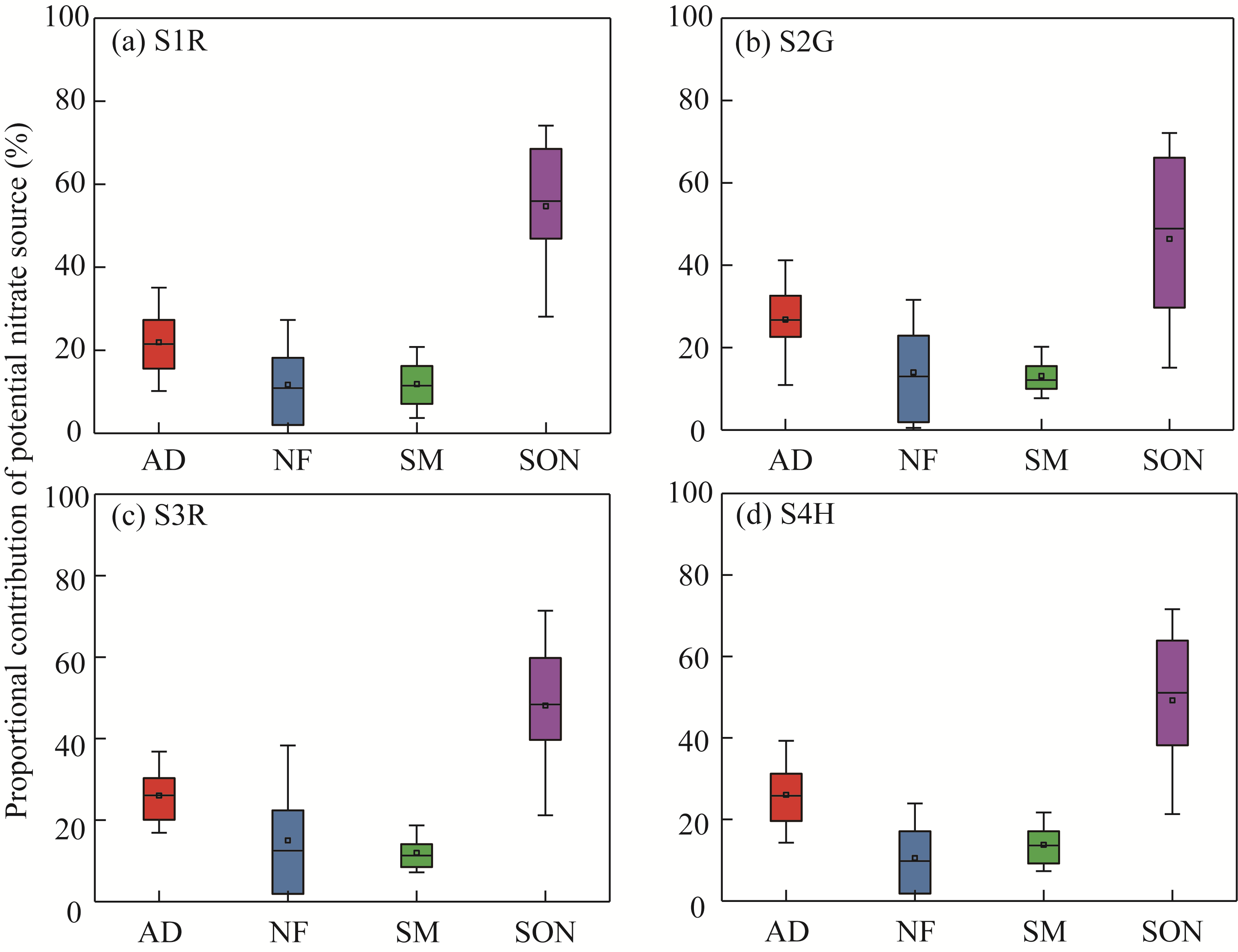
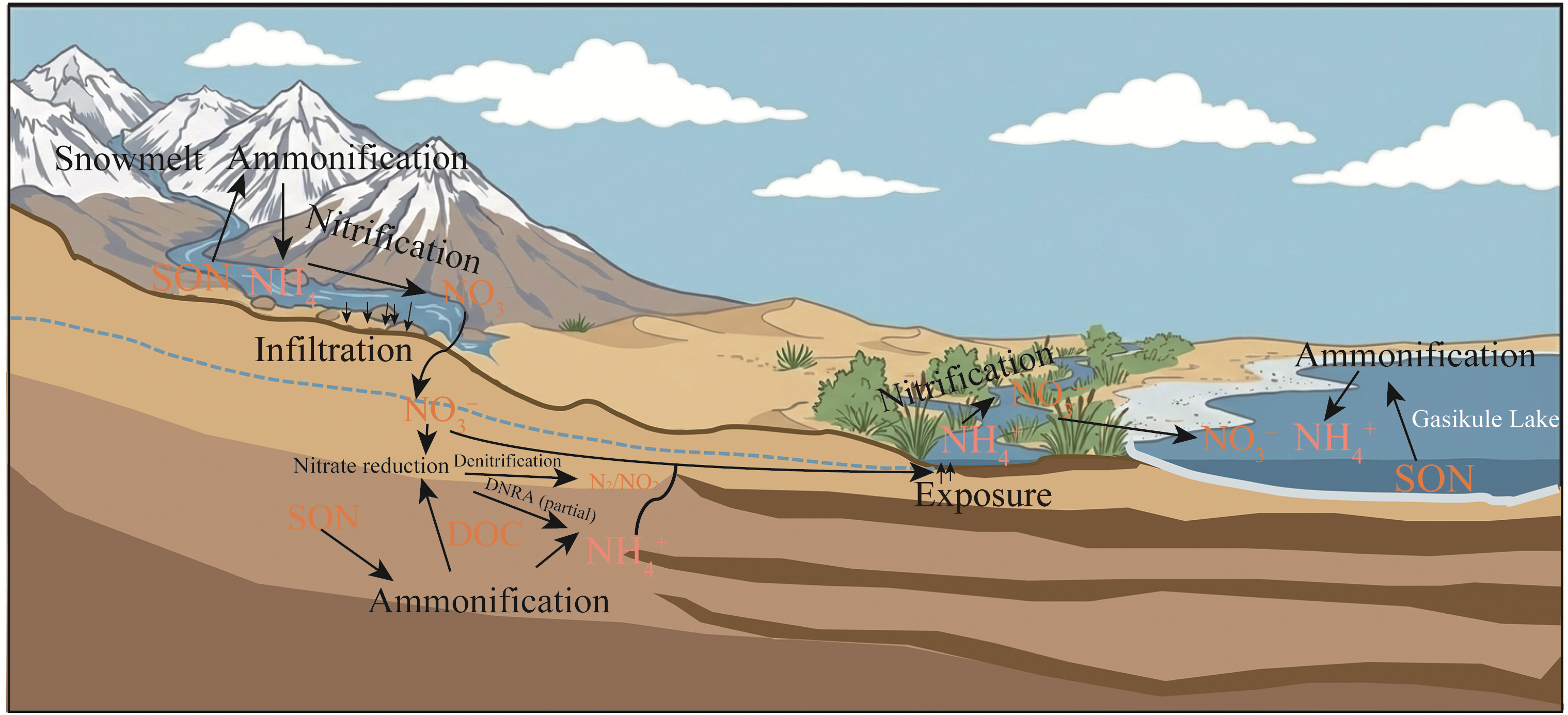
Abstract Arid areas account for approximately one-quarter of the global land surface. Therefore, a comprehensive understanding of nitrogen cycling in arid watershed systems is essential for water environment protection and land use planning in dryland ecosystems. Using the Gasikule Lake Basin on the Qinghai-Xizang Plateau, China, as a representative study area, this study examined the sources, transport, and transformation mechanisms of nitrogen within a hierarchically nested hydrological system, including river water (S1R), groundwater (S2G), spring-fed river (S3R), and lake water (S4H). Dual nitrate isotopes (δ15N-NO3- and δ18O-NO3-) were integrated with a Bayesian mixing models in R (MixSIAR) to quantify external nitrate sources. In addition, δ15N-NH4+ isotopes combined with microbial techniques were applied to trace nitrogen transformation processes in water bodies, where nitrogen inputs were dominated by nitrate. The results indicated that nitrate was the primary form of nitrogen input across the study area, although overall nitrate loading remained relatively low. Atmospheric deposition and soil organic nitrogen were the dominant sources of exogenous nitrate input. Microbial genera associated with nitrate reduction generally showed low relative abundance in groundwater, whereas facultatively aerobic genera were predominant in surface water. In surface water, nitrogen transformation was mainly driven by organic nitrogen ammoniation and subsequent nitrification. In contrast, groundwater systems were characterized by stronger hydrological confinement and oxygen limitation, resulting in suppressed nitrification, incomplete denitrification, and a tendency toward ammonium accumulation. Collectively, these findings define a "low-input, low-transformation, and low-loss" nitrogen regime in the Gasikule Lake Basin. This sluggish nitrogen cycling reflects a limited ecological self-remediation capacity, highlighting the inherent biogeochemical fragility of alpine desert ecosystems. This study provides a critical theoretical basis for understanding nitrogen budgets in global dryland systems and offers scientific support for water environment protection and ecological sustainability in high-altitude areas.
|
|
Received: 24 October 2025
Published: 31 May 2026
|
|
Corresponding Authors:
*WAN Yuyu (E-mail: wanyuyu@jlu.edu.cn)
|
| About author: Author contributions
Conceptualization: ZHAO Yongjia; Formal analysis: ZHAO Yongjia; Data curation: ZHAO Yongjia, TANG Wangchun, TAN Liwei, YI Xiaokun; Visualization: ZHAO Yongjia; Writing - original draft preparation: ZHAO Yongjia; Validation: ZHAO Yongjia; Resources: WAN Yuyu, SU Xiaosi, ZHANG Qixing, DAI Yadi; Investigation: WAN Yuyu, SU Xiaosi, ZHANG Qixing, TANG Wangchun, TAN Liwei, YI Xiaokun, DAI Yadi; Writing - review and editing: WAN Yuyu; Project administration: WAN Yuyu; Funding acquisition: WAN Yuyu; Supervision: ZHANG Qixing. All authors approved the manuscript.
|
| Cite this article:
ZHAO Yongjia, WAN Yuyu, SU Xiaosi, ZHANG Qixing, TANG Wangchun, TAN Liwei, YI Xiaokun, DAI Yadi. Nitrogen cycling mechanisms in aquatic systems of arid areas on the Qinghai-Xizang Plateau, China. Journal of Arid Land, 2026, 18(5): 811-832.
URL:
http://jal.xjegi.com/10.1016/j.jaridl.2026.05.005 OR http://jal.xjegi.com/Y2026/V18/I5/811
|
|
|
| [1] |
Asamoto C K, Rempfert K R, Luu V H, et al. 2021. Enzyme-specific coupling of oxygen and nitrogen isotope fractionation of the Nap and Nar nitrate reductases. Environmental Science & Technology, 55(8): 5537-5546.
doi: 10.1021/acs.est.0c07816
|
|
|
| [2] |
Barnes C J, Jacobson G, Smith G D. 1992. The origin of high-nitrate ground waters in the Australian arid zone. Journal of Hydrology, 137(1-4): 181-197.
doi: 10.1016/0022-1694(92)90055-Z
|
|
|
| [3] |
Biddau R, Dore E, Da Pelo S, et al. 2023. Geochemistry, stable isotopes and statistic tools to estimate threshold and source of nitrate in groundwater (Sardinia, Italy). Water Research, 232: 119663, doi: 10.1016/j.watres.2023.119663.
|
|
|
| [4] |
Cao M D, Yin X J, Zhang J, et al. 2022. Sources and transformations of nitrogen in an agricultural watershed on the Jianghan Plain, China: An integration of δ15N-NH4+, δ15N-NO3-, δ18O-NO3- and a Bayesian isotope mixing model. Applied Geochemistry, 142: 105329, doi: 10.1016/j.apgeochem.2022.105329.
|
|
|
| [5] |
Chen X L, Sheng Y Z, Wang G C, et al. 2024. Spatiotemporal successions of N, S, C, Fe, and As cycling genes in groundwater of a wetland ecosystem: Enhanced heterogeneity in wet season. Water Research, 251: 121105, doi: 10.1016/j.watres.2024.121105.
|
|
|
| [6] |
Clark S, Barnes R, Oleksy I, et al. 2021. Persistent nitrate in alpine waters with changing atmospheric deposition and warming trends. Environmental Science & Technology, 55(21): 14946-14956.
doi: 10.1021/acs.est.1c02515
|
|
|
| [7] |
Cook E, Sponseller R, Grimm N, et al. 2018. Mixed method approach to assess atmospheric nitrogen deposition in arid and semi-arid ecosystems. Environmental Pollution, 239: 617-630.
doi: S0269-7491(17)33935-0
pmid: 29705717
|
|
|
| [8] |
Deng Y D, Ye X Y, Feng J, et al. 2024. Assessment of soil-groundwater nitrogen cycling processes in the agricultural region through flux model, stable isotope. Journal of Hydrology, 639: 131604, doi: 10.1016/j.jhydrol.2024.131604.
|
|
|
| [9] |
Denk T, Mohn J, Decock C, et al. 2017. The nitrogen cycle: A review of isotope effects and isotope modeling approaches. Soil Biology and Biochemistry, 105: 121-137.
doi: 10.1016/j.soilbio.2016.11.015
|
|
|
| [10] |
Dietzel M, Leis A, Abdalla R, et al. 2014. 17O excess traces atmospheric nitrate in paleo-groundwater of the Saharan desert. Biogeosciences, 11(12): 3149-3161.
doi: 10.5194/bg-11-3149-2014
|
|
|
| [11] |
Ding Y, Shi Q, Ouyang L L, et al. 2022. Isotopic source identification of nitrogen pollution in the Pi River in Chengdu. Integrated Environmental Assessment and Management, 18(6): 1609-1620.
doi: 10.1002/ieam.4589
pmid: 35118803
|
|
|
| [12] |
Feng B, Zhong Y X, He J, et al. 2023. Nitrogen sources and conversion processes in shallow groundwater around a plain lake (Northwest China): Evidenced by multiple isotopes and water chemistry. Chemosphere, 337: 139322, doi: 10.1016/j.chemosphere.2023.139322.
|
|
|
| [13] |
Gao G Y, Shen Q, Zhang Y, et al. 2018. Determining spatio-temporal variations of ecological water consumption by natural oases for sustainable water resources allocation in a hyper-arid endorheic basin. Journal of Cleaner Production, 185: 1-13.
doi: 10.1016/j.jclepro.2018.03.025
|
|
|
| [14] |
Grzyb A, Wolna-Maruwka A, Niewiadomska A. 2021. The significance of microbial transformation of nitrogen compounds in the light of integrated crop management. Agronomy, 11(7): 1415, doi: 10.3390/agronomy11071415.
|
|
|
| [15] |
Guo L, Xie Q, Sheng Y Z, et al. 2022. Co-variation of hydrochemistry, inorganic nitrogen, and microbial community composition along groundwater flow path: A case study in Linzhou-Anyang area, Southern North China plain. Applied Geochemistry, 140: 105296, doi: 10.1016/j.apgeochem.2022.105296.
|
|
|
| [16] |
Gutiérrez M, Biagioni R, Alarcón-Herrera M, et al. 2018. An overview of nitrate sources and operating processes in arid and semiarid aquifer systems. Science of The Total Environment, 624: 1513-1522.
doi: 10.1016/j.scitotenv.2017.12.252
|
|
|
| [17] |
Han L L, Wang H L, Ge L H, et al. 2023. Transition of source/sink processes and fate of ammonium in groundwater along with redox gradients. Water Research, 231: 119600, doi: 10.1016/j.watres.2023.119600.
|
|
|
| [18] |
Hayat S, Li P, Menhas S, et al. 2025. Exploring the nutrient nexus in environmental systems: Nitrogen and phosphorus cycling, removal, recovery, and management. Environmental Research, 284: 122162, doi: 10.1016/j.envres.2025.122162.
|
|
|
| [19] |
Ji L, Zhang L, Wang Z, et al. 2022a. High biodiversity and distinct assembly patterns of microbial communities in groundwater compared with surface water. Science of The Total Environment, 834: 155345, doi: 10.1016/j.scitotenv.2022.155345.
|
|
|
| [20] |
Ji X L, Shu L L, Chen W L, et al. 2022b. Nitrate pollution source apportionment, uncertainty and sensitivity analysis across a rural-urban river network based on δ15N/δ18O-NO3- isotopes and SIAR modeling. Journal of Hazardous Materials, 438: 129480, doi: 10.1016/j.jhazmat.2022.129480.
|
|
|
| [21] |
Jiang X, Liu C, Hu Y, et al. 2022. Salinity-linked denitrification potential in endorheic Lake Bosten (China) and its sensitivity to climate change. Frontiers in Microbiology, 13: 922546, doi: 10.3389/fmicb.2022.922546.
|
|
|
| [22] |
Lei M, Long Y, Li T X, et al. 2025. Hydrological connectivity on watershed nitrogen transport processes: A review. Applied Water Science, 15: 169, doi: 10.1007/s13201-025-02530-1.
|
|
|
| [23] |
Li K H, Liu X J, Geng F Z, et al. 2021. Inorganic nitrogen deposition in arid land ecosystems of Central Asia. Environmental Science and Pollution Research, 28: 31861-31871.
doi: 10.1007/s11356-021-13022-5
|
|
|
| [24] |
Li W Z, El-Askary H, Thomas R, et al. 2020. An assessment of the hydrological trends using synergistic approaches of remote sensing and model evaluations over global arid and semi-arid regions. Remote Sensing, 12(23): 3973, doi: 10.3390/rs12233973.
|
|
|
| [25] |
Li Y K, Zou N, Liang X J, et al. 2023. Effects of nitrogen input on soil bacterial community structure and soil nitrogen cycling in the rhizosphere soil of Lycium barbarum L. Frontiers in Microbiology, 13: 1070817, doi: 10.3389/fmicb.2022.1070817.
|
|
|
| [26] |
Liang Y, Ma R, Wang Y X, et al. 2020. Hydrogeological controls on ammonium enrichment in shallow groundwater in the central Yangtze River Basin. Science of The Total Environment, 741: 140350, doi: 10.1016/j.scitotenv.2020.140350.
|
|
|
| [27] |
Lin C K, Du R H, Guo F. 2024. Implication of self-organizing map, stable isotopes combined with MixSIAR model for accurate nitrogen control in a well-protected reservoir. Environmental Research, 248: 118335, doi: 10.1016/j.envres.2024.118335.
|
|
|
| [28] |
Lin M, Hattori S, Wang K, et al. 2020. A complete isotope (δ15N, δ18O, Δ17O) investigation of atmospherically deposited nitrate in glacial-hydrologic systems across the Third Pole region. Journal of Geophysical Research: Atmospheres, 125(19): e2019JD031878, doi: 10.1029/2019jd031878.
|
|
|
| [29] |
Liu Y B, Yuan Y S, Zhang L, et al. 2024. Exploring the differences of moisture traceability methods based on MixSIAR model under different nitrogen applications of wheat in the arid region of Northwest China. Agricultural Water Management, 294: 108716, doi: 10.1016/j.agwat.2024.108716.
|
|
|
| [30] |
Ma B, Zhang X N, Wen Z, et al. 2026. Ammonium and N2O production pathways in quaternary hill-plain groundwater: Evidence from multi-isotope and isotopomer analysis. Water Research, 292: 125360, doi: 10.1016/j.watres.2026.125360.
|
|
|
| [31] |
Mattoo R, Suman B M. 2023. Microbial roles in the terrestrial and aquatic nitrogen cycle—implications in climate change. FEMS Microbiology Letters, 370: fnad061, doi: 10.1093/femsle/fnad061.
|
|
|
| [32] |
McLaughlin K, Nezlin N, Howard M, et al. 2017. Rapid nitrification of wastewater ammonium near coastal ocean outfalls, Southern California, USA. Estuarine, Coastal and Shelf Science, 186: 263-275.
doi: 10.1016/j.ecss.2016.05.013
|
|
|
| [33] |
Nyilitya B, Mureithi S, Bauters M, et al. 2021. Nitrate source apportionment in the complex Nyando tropical river basin in Kenya. Journal of Hydrology, 594: 125926, doi: 10.1016/j.jhydrol.2020.125926.
|
|
|
| [34] |
Pan Y C, She D L, Ding J H, et al. 2024. Coping with groundwater pollution in high-nitrate leaching areas: The efficacy of denitrification. Environmental Research, 250: 118484, doi: 10.1016/j.envres.2024.118484.
|
|
|
| [35] |
Qi H K, Liu Y. 2023. Nitrogen removal through denitrification in China's aquatic system. Science of The Total Environment, 891: 164317, doi: 10.1016/j.scitotenv.2023.164317.
|
|
|
| [36] |
Qi S, Ma J Z, Feng Q, et al. 2018. NO3- sources and circulation in the shallow vadose zone in the edge of Dunhuang Mingsha sand dunes in an extremely arid area of Northwestern China. CATENA, 162:193-202.
doi: 10.1016/j.catena.2017.11.012
|
|
|
| [37] |
Qi S, Feng Q, Zhu M, et al. 2022. Source apportionment of nitrates in different aquifers in an arid region, northwestern China. Journal of Cleaner Production, 374: 133969, doi: 10.1016/j.jclepro.2022.133969.
|
|
|
| [38] |
Qiu H L, Gui H R, Xu H F, et al. 2023. Quantifying nitrate pollution sources of shallow groundwater and related health risks based on deterministic and Monte Carlo models: A study in Huaibei mining area, Huaibei coalfield, China. Ecotoxicology and Environmental Safety, 249: 114434, doi: 10.1016/j.ecoenv.2022.114434.
|
|
|
| [39] |
Qu S, Wang C Y, Yang N, et al. 2023. Large-scale surface water-groundwater origins and connectivity in the Ordos Basin, China: Insight from hydrogen and oxygen isotopes. Environmental Research, 236: 116837, doi: 10.1016/j.envres.2023.116837.
|
|
|
| [40] |
Ren B, Ma X, Li D, et al. 2024. Nitrogen-cycling microbial communities respond differently to nitrogen addition under two contrasting grassland soil types. Frontiers in Microbiology, 15: 1290248, doi: 10.3389/fmicb.2024.1290248.
|
|
|
| [41] |
Riha K, Michalski G, Gallo E, et al. 2014. High atmospheric nitrate inputs and nitrogen turnover in semi-arid urban catchments. Ecosystems, 17: 1309-1325.
doi: 10.1007/s10021-014-9797-x
|
|
|
| [42] |
Saka D, Adu-Gyamfi J, Skrzypek G, et al., 2023. Disentangling nitrate pollution sources and apportionment in a tropical agricultural ecosystem using a multi-stable isotope model. Environmental Pollution, 328: 121589, doi: 10.1016/j.envpol.2023.121589.
|
|
|
| [43] |
Shang Y K, Wang F, Sun S C, et al. 2022. Sources and transformations of nitrate in Qixiangcuo Lake and its inflow rivers in the northern Tibetan Plateau. Environmental Science and Pollution Research, 30: 4245-4257.
doi: 10.1007/s11356-022-22542-7
|
|
|
| [44] |
Sheng Y Z, Wang G C, Zhao D, et al. 2018. Groundwater microbial communities along a generalized flow path in Nomhon area, Qaidam Basin, China. Ground Water, 56(5): 719-731.
doi: 10.1111/gwat.2018.56.issue-5
|
|
|
| [45] |
Sheng Y Z, Baars O, Guo D Y, et al. 2023. Mineral-bound trace metals as cofactors for anaerobic biological nitrogen fixation. Environmental Science & Technology, 57(18): 7206-7216.
doi: 10.1021/acs.est.3c01371
|
|
|
| [46] |
Song W M, Chen S P, Zhou Y D, et al. 2020. Rainfall amount and timing jointly regulate the responses of soil nitrogen transformation processes to rainfall increase in an arid desert ecosystem. Geoderma, 364: 114197, doi: 10.1016/j.geoderma.2020.114197.
|
|
|
| [47] |
Stober I, Zhong J, Bucher K. 2023. From freshwater inflows to salt lakes and salt deposits in the Qaidam Basin, W China. Swiss Journal of Geosciences, 116: 5, doi: 10.1186/s00015-023-00433-4.
|
|
|
| [48] |
Stock B C, Jackson A L, Ward E J, et al. 2018. Analyzing mixing systems using a new generation of Bayesian tracer mixing models. PeerJ, 6: e5096, doi: 10.7717/peerj.5096.
|
|
|
| [49] |
Suolang Y Z, Luo W X, Ma J W, et al. 2024. Extreme precipitation alters soil nitrogen cycling related microbial community in karst abandoned farmland. Applied Soil Ecology, 197: 105345, doi: 10.1016/j.apsoil.2024.105345.
|
|
|
| [50] |
Wang J X, Ma Z T, Wang Z F, et al. 2023. Evolution of the landscape ecological pattern in arid riparian zones based on the perspective of watershed river-groundwater transformation. Journal of Hydrology, 625: 130119, doi: 10.1016/j.jhydrol.2023.130119.
|
|
|
| [51] |
Wang Y, Yang W Z, Jiao Y, et al. 2024. Quantitative analysis of dissolved carbon sources in the farmland artificial ditch drainage-Lake UlanSuhai continuum in the Hetao Irrigation District, Inner Mongolia. Journal of Hydrology: Regional Studies, 55: 101910, doi: 10.1016/j.ejrh.2024.101910.
|
|
|
| [52] |
Wheater H. 2025. Why is arid zone hydrology a scientific desert and how does the hydrological community move forward? Environmental Modelling & Software, 192: 106561, doi: 10.1016/j.envsoft.2025.106561.
|
|
|
| [53] |
Wu F, Yang X L, Yuan X, et al. 2024. How will drought evolve in global arid zones under different future emission scenarios? Journal of Hydrology: Regional Studies, 51: 101661, doi: 10.1016/j.ejrh.2024.101661.
|
|
|
| [54] |
Wu Y L, Wang J, Liu Z A, et al. 2025. Seasonal nitrate input drives the spatiotemporal variability of regional surface water-groundwater interactions, nitrate sources and transformations. Journal of Hydrology, 655: 132973, doi: 10.1016/j.jhydrol.2025.132973.
|
|
|
| [55] |
Xiong G Y, Zhu X B, Liu M W, et al. 2023. Nitrogen cycle pattern variations during seawater-groundwater-river interactions enhance the nitrogen availability in the coastal earth critical zone. Journal of Hydrology, 624: 129932, doi: 10.1016/j.jhydrol.2023.129932.
|
|
|
| [56] |
Xu S G, Kang P P, Sun Y. 2015. A stable isotope approach and its application for identifying nitrate source and transformation process in water. Environmental Science and Pollution Research, 23: 1133-1148.
doi: 10.1007/s11356-015-5309-6
|
|
|
| [57] |
Yan Z F, Chang B X, Song X T, et al. 2024. A microbial-explicit model with comprehensive nitrogen processes to quantify gaseous nitrogen production from agricultural soils. Soil Biology and Biochemistry, 189: 109284, doi: 10.1016/j.soilbio.2023.109284.
|
|
|
| [58] |
Yang L P, Han J P, Xue J L, et al. 2013. Nitrate source apportionment in a subtropical watershed using Bayesian model. Science of The Total Environment, 463-464: 340-347.
doi: 10.1016/j.scitotenv.2013.06.021
|
|
|
| [59] |
Yi Q T, Chen Q W, Hu L M, et al. 2017. Tracking nitrogen sources, transformation, and transport at a basin scale with complex plain river networks. Environmental Science & Technology, 51(10): 5396-5403.
doi: 10.1021/acs.est.6b06278
|
|
|
| [60] |
Yu H Y, Li L, Ma Q H, et al. 2023. Soil microbial responses to large changes in precipitation with nitrogen deposition in an arid ecosystem. Ecology, 104(5): e4020, doi: 10.1002/ecy.4020.
pmid: 36883305
|
|
|
| [61] |
Zhang A Q, Lei K, Lang Q, et al. 2022a. Identification of nitrogen sources and cycling along freshwater river to estuarine water continuum using multiple stable isotopes. Science of The Total Environment, 851: 158136, doi: 10.1016/j.scitotenv.2022.158136.
|
|
|
| [62] |
Zhang B J, Li Z X, Feng Q, et al. 2022b. Environmental significance of atmospheric nitrogen deposition in the transition zone between the Tibetan Plateau and arid region. Chemosphere, 307: 136096, doi: 10.1016/j.chemosphere.2022.136096.
|
|
|
| [63] |
Zhang G Z, Yang H, Zhang W P, et al. 2023a. Interspecific interactions between crops influence soil functional groups and networks in a maize/soybean intercropping system. Agriculture, Ecosystems & Environment, 355: 108595, doi: 10.1016/j.agee.2023.108595.
|
|
|
| [64] |
Zhang W, Ruan X H, Bai Y, et al. 2018. The characteristics and performance of sustainable-releasing compound carbon source material applied on groundwater nitrate in-situ remediation. Chemosphere, 205: 635-642.
doi: S0045-6535(18)30782-3
pmid: 29729621
|
|
|
| [65] |
Zhang Y Q, Ren Z R, Lu H N, et al. 2023b. Autumn nitrogen enrichment destabilizes ecosystem biomass production in a semiarid grassland. Fundamental Research, 3(2): 170-178.
doi: 10.1016/j.fmre.2022.08.014
|
|
|
| [66] |
Zhao Z, Zhao Y X, Marotta F, et al. 2024. The microbial community structure and nitrogen cycle of high-altitude pristine saline lakes on the Qinghai-Tibetan plateau. Frontiers in Microbiology, 15: 1424368, doi: 10.3389/fmicb.2024.1424368.
|
|
|
|
Viewed |
|
|
|
Full text
|
|
|
|
|
Abstract
|
|
|
|
|
Cited |
|
|
|
|
| |
Shared |
|
|
|
|
| |
Discussed |
|
|
|
|