In the arid regions of northern Xinjiang Uygur Autonomous Region (hereafter referred to as northern Xinjiang), China developing intensive and sustainable cropping patterns is crucial for ensuring food security and promoting green agricultural development. As a typical cereal and legume intercropping system, maize and peanut intercropping demonstrates significant potential to enhance yield and resource use efficiency. However, the effects of nitrogen management and row configuration on crop productivity and inter-specific interactions under the unique ecological conditions of in northern Xinjiang remain unclear. This study employed a field experiment with four planting patterns (maize monoculture (MM), peanut monoculture (MP), four rows of maize intercropped with four rows of peanuts (4M4P), and six rows of maize intercropped with six rows of peanuts (6M6P)) and five nitrogen application levels (0 (N0), 100 (N100), 200 (N200), 300 (N300), and 400 (N400) kg/hm2). The results showed that under the 6M6P intercropping pattern combined with the N200 application level, maize morphological parameters were significantly improved, with plant height increasing by 10.48%, stem base circumference by 13.64%, and root length density (RLD) by 47.63%. Additionally, adaptive root morphological responses of maize were promoted in deeper soil depths, with RLD increasing by 15.48%-54.76% in the 0-60 cm soil depth. Intercropping significantly inhibited peanut growth and root development, as reflected by reductions of 12.37% in main stem height, 27.01% in dry matter weight, and 15.73%-25.23% in RLD in the 0-20 cm soil dept. However, nitrogen application at the N200 level effectively alleviated this inhibition, increasing peanut aboveground nitrogen accumulation by 80.12%-92.93% compared with the N0 level. Although the peanut nitrogen harvest index (NHI) decreased by 6.21%-7.06% relative to MM, it remained at a relatively high level. This planting configuration also significantly enhanced maize dry matter accumulation (increased by 28.50%) and nitrogen uptake (increased by 38.65%-55.21%) compared with MM. The nitrogen use efficiency (NUE) of both crops was the highest at the N100 and N200 levels, whereas N300 and N400 levels suppressed the aforementioned indicators. A positive correlation was observed between dry matter accumulation and nitrogen accumulation. Nitrogen translocation was enhanced in maize and allocation to grains was improved through improved morphological plasticity and root system adaptation, as reflected by its NHI, remaining at a high level of 79.54%-83.00%. This configuration achieved the highest land equivalent ratio (1.30) and maize grain yield under the experimental conditions. Together, these findings elucidate how nitrogen management and row configuration regulate crop growth and competitive dynamics in intercropping systems, providing a scientific basis for optimizing cereal and legume intercropping management in arid regions.
Received: 22 January 2026
Published: 31 August 2026
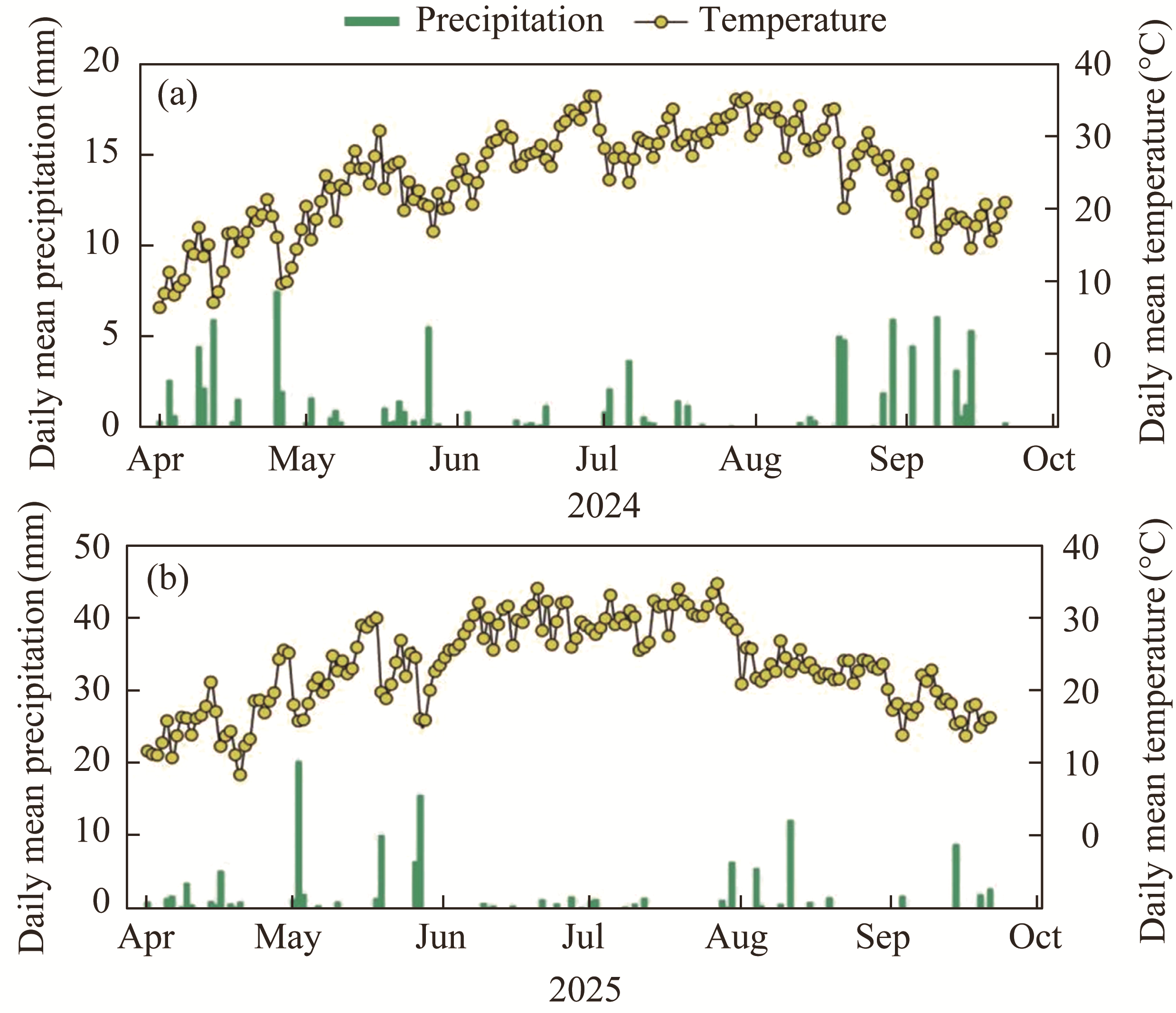
Fig. 1Daily mean temperature and precipitation during the whole crop period in 2024 (a) and 2025 (b)
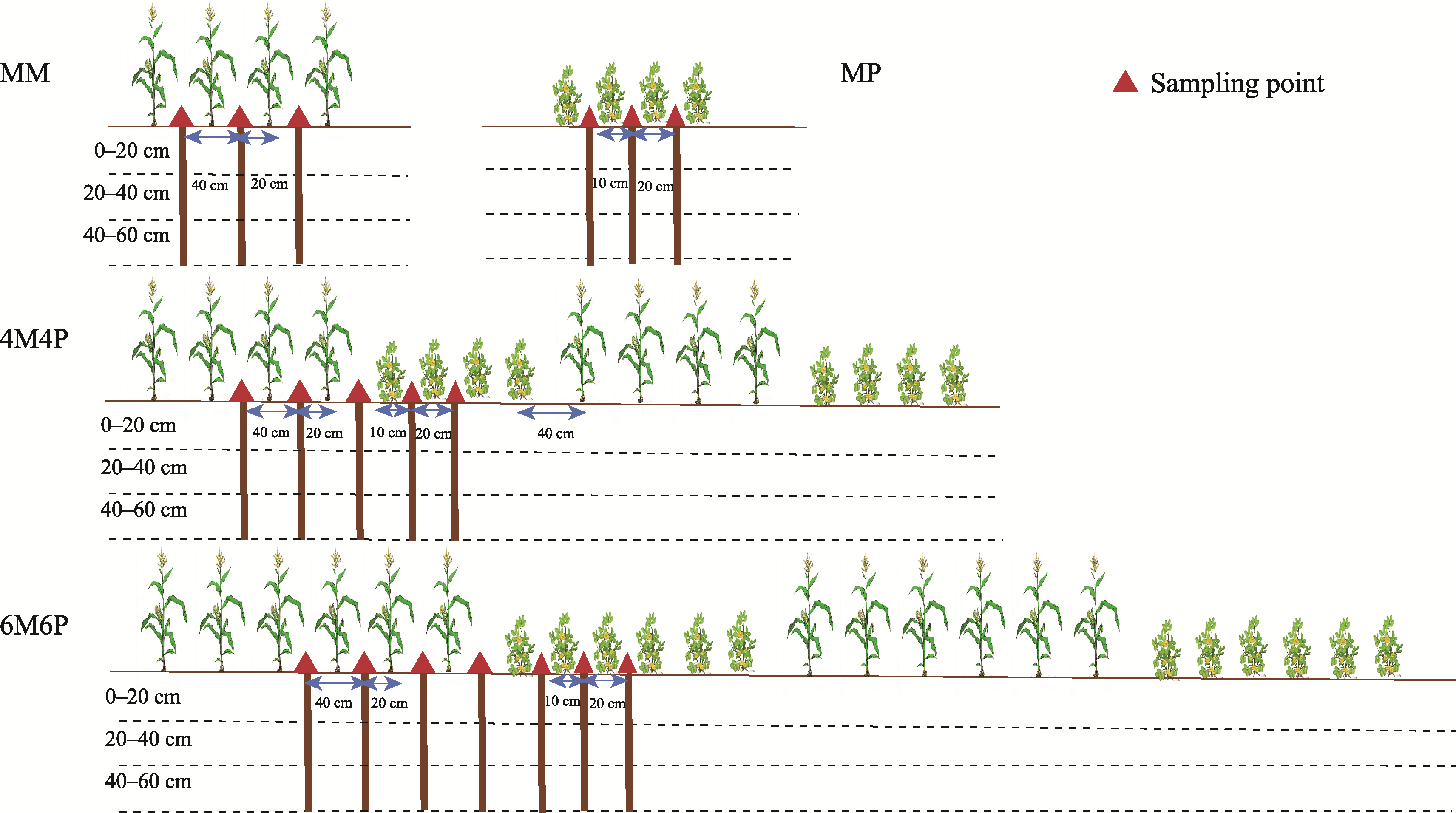
Fig. 2Schematic diagram of planting patterns and sampling points. MM, monoculture maize; MP, monoculture peanut; 4M4P, four rows of maize intercropped with four rows of peanuts; 6M6P, six rows of maize intercropped with six rows of peanuts.
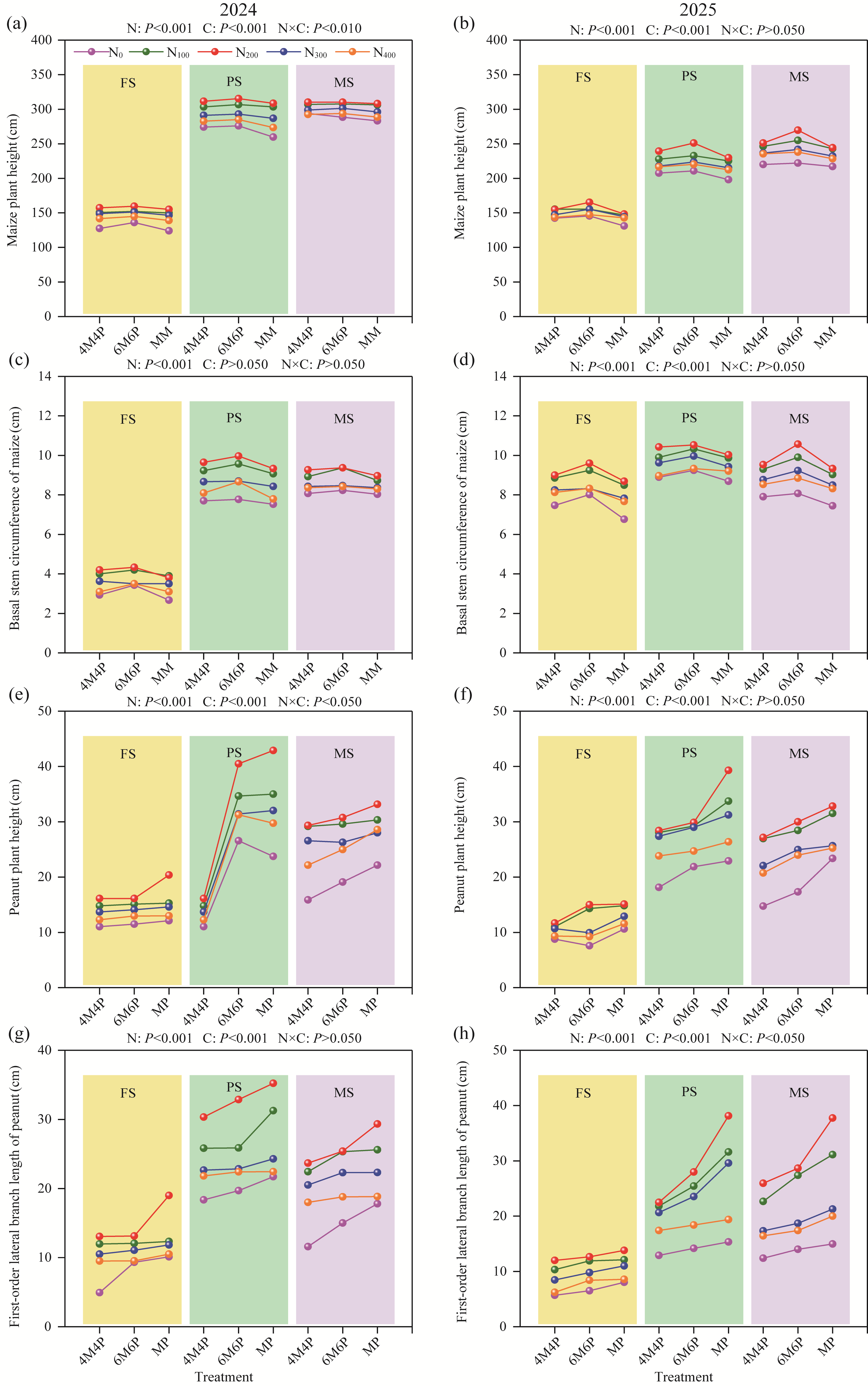
Fig. 3Plant height and stem base circumference of maize (a-d) and plant height and first-order lateral branch length of peanut (e-h) under four planting systems. FS, large trumpet stage for maize and flowering-pegging stage for peanut, respectively; PS, tasseling stage for maize and pod-setting stage for peanut, respectively; MS, maturity stage; N0-N400, nitrogen application rates of 0, 100, 200, 300, and 400 kg/hm2, respectively. N, nitrogen fertilizer level; C, cropping pattern; N×C; their interaction.
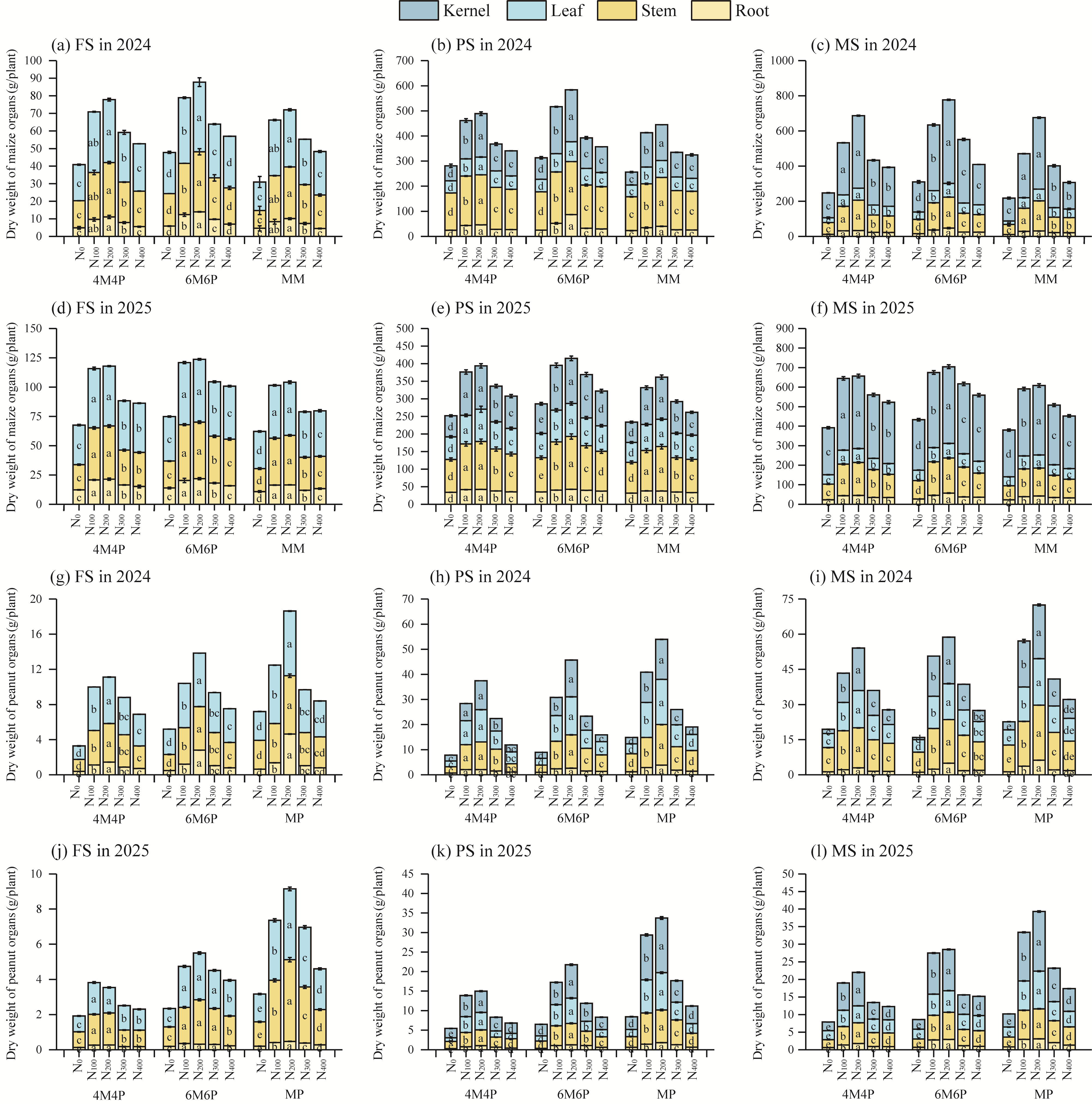
Fig. 4Dry weight of different organs in maize (a-f) and peanut (g-l) under four planting systems. Different lowercase letters indicate significant differences between different nitrogen application level treatments under the same planting pattern and plant organ at P<0.050 level. Bars are standard errors.
Fig. 5Root length density (RDL) of maize (a-f) and peanut (g-l) under four planting systems. Different lowercase letters indicate significant differences among different nitrogen application level treatments under the same cultivation pattern and same soil depth at P<0.050 level.
Fig. 6Specific root length (SRL) of maize (a-f) and peanut (g-l) under four planting systems. Different lowercase letters indicate significant differences among different nitrogen application level treatments under the same cultivation pattern and same soil depth at P<0.050 level.
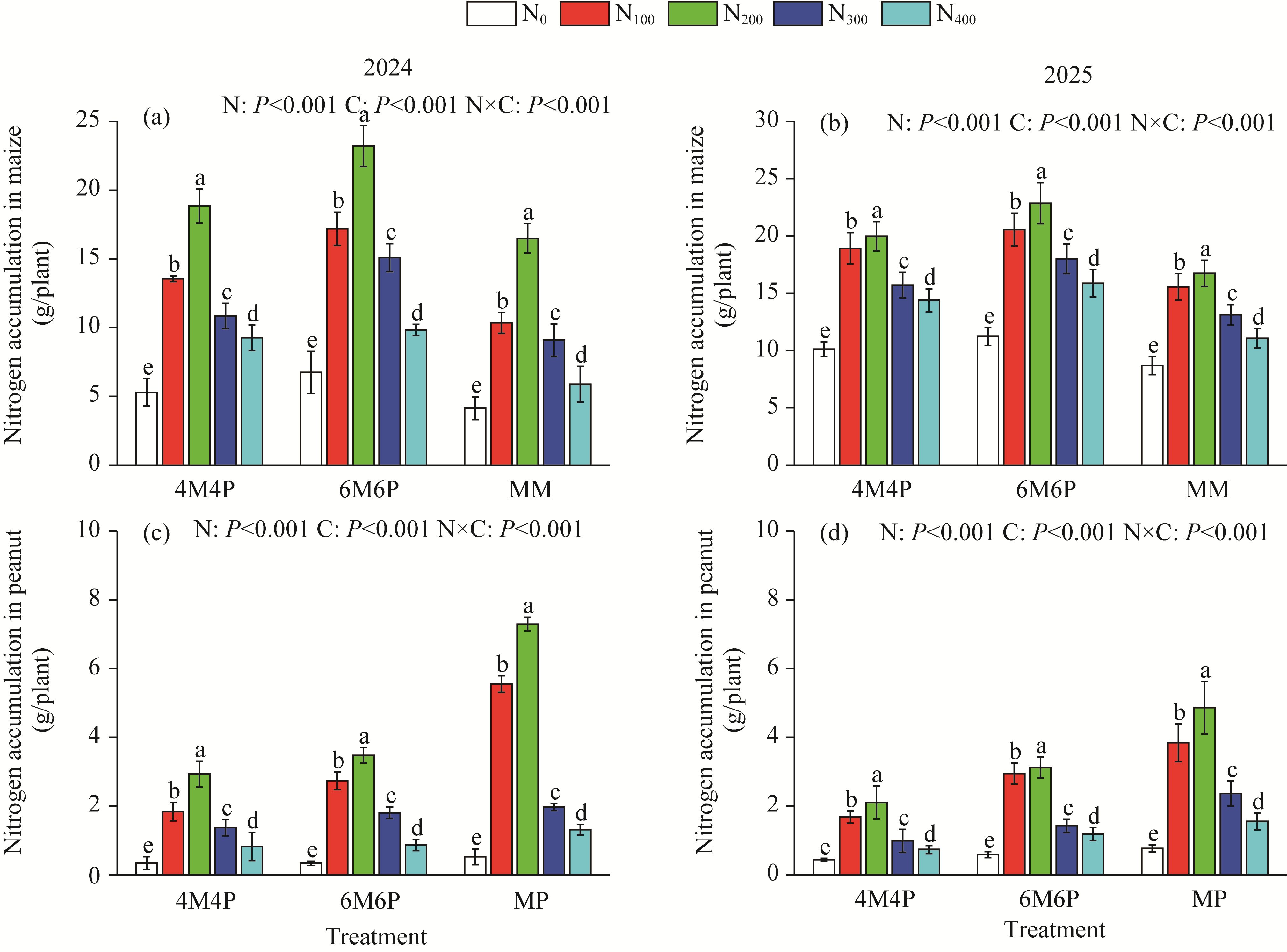
Fig. 7Accumulation of N content in the aboveground parts of mature maize (a and b) and peanut (c and d). Different lowercase letters indicate significant differences between different nitrogen application level treatments under the same planting pattern at P<0.050 level. Bars are standard errors.
Year
Nitrogen level
NHI (%)
NAE (kg/kg)
NUE (%)
MM
4M4P
6M6P
MM
4M4P
6M6P
MM
4M4P
6M6P
2024
N0
84.47
82.44
79.49
-
-
-
-
-
-
N100
77.19
77.76
80.25
44.90
22.06
32.63
19.42
25.79
32.70
N200
79.60
79.23
80.96
26.20
13.26
22.00
19.31
21.16
25.74
N300
82.93
79.49
83.93
12.40
4.65
5.31
5.16
5.77
8.70
N400
77.86
78.79
78.35
6.71
0.89
1.41
1.36
3.10
2.42
Mean
80.41
79.54
80.60
22.55
10.22
15.34
11.31
13.95
17.39
2025
N0
85.27
84.45
82.90
-
-
-
-
-
-
N100
80.94
79.31
79.49
47.54
23.22
34.58
21.49
27.54
29.18
N200
78.94
77.28
77.99
27.75
13.98
23.30
12.59
15.39
18.19
N300
84.85
80.60
80.06
13.14
4.88
5.62
4.61
5.83
7.06
N400
85.01
82.50
82.36
7.11
0.91
1.50
1.87
3.34
3.63
Mean
83.00
80.83
80.56
23.88
10.75
16.25
10.14
13.02
14.51
Table 1 Effects of N application and planting patterns on N utilization of maize
Year
Nitrogen level
NHI (%)
NAE (kg/kg)
NUE (%)
MP
4M4P
6M6P
MP
4M4P
6M6P
MP
4M4P
6M6P
2024
N0
58.46
38.10
26.19
-
-
-
-
-
-
N100
71.18
63.04
72.22
11.26
8.23
7.52
6.29
1.88
3.00
N200
57.13
61.48
69.35
13.79
6.75
6.39
4.27
1.62
1.96
N300
65.45
63.74
65.78
3.63
2.34
1.36
0.60
0.43
0.61
N400
63.41
58.25
47.22
0.72
1.66
0.82
0.25
0.15
0.17
Mean
63.13
56.92
56.15
7.35
4.75
4.02
2.85
1.02
1.43
2025
N0
75.79
67.86
69.86
-
-
-
-
-
-
N100
78.13
74.76
79.62
10.63
5.69
7.11
3.85
1.54
2.95
N200
77.76
77.57
79.23
13.03
5.33
6.04
2.56
1.04
1.59
N300
78.04
69.11
73.03
3.43
1.67
1.43
0.67
0.22
0.35
N400
74.74
67.39
69.59
0.68
0.94
0.68
0.25
0.09
0.19
Mean
76.89
71.34
74.27
6.94
3.41
3.81
1.83
0.72
1.27
Table 2 Effects of N application and planting patterns on N utilization of peanut
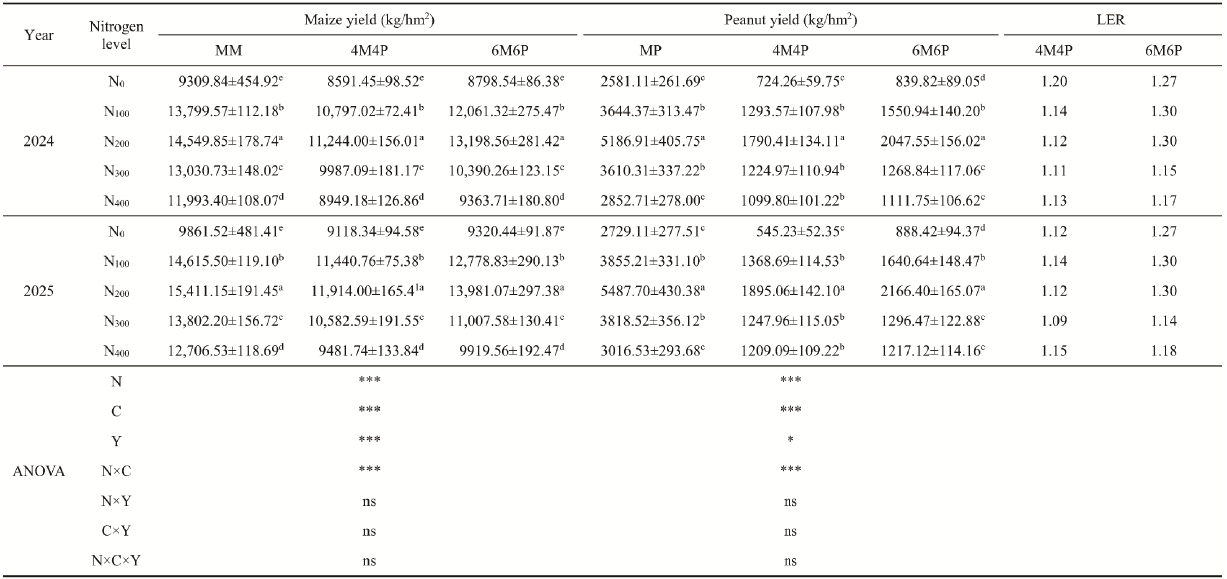
Table 3 Maize yield, peanut yield, and land equivalent ratio (LER) under different treatments
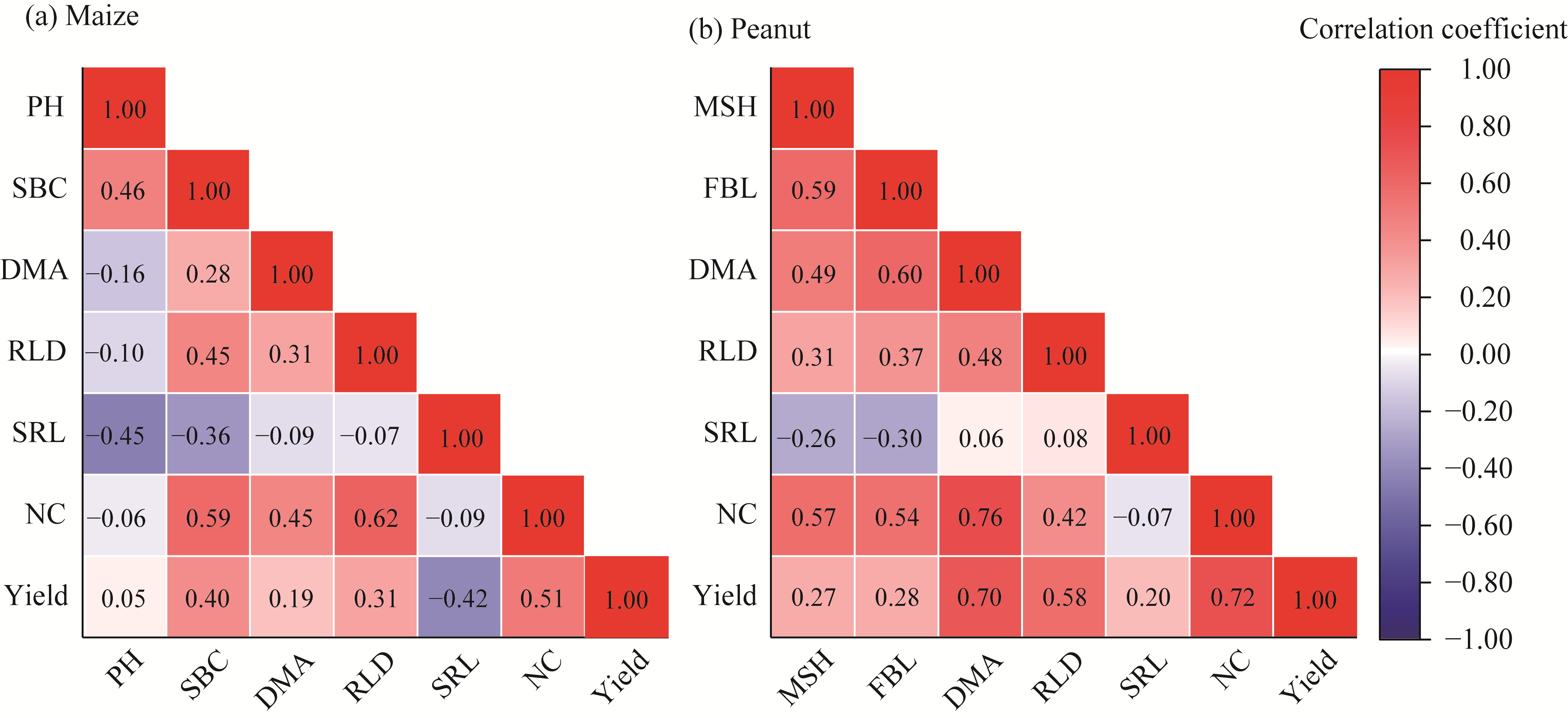
Fig. 8Correlations between yield and measured traits for maize (a) and peanut (b). PH, plant height; SBC, stem base circumference; DMA, dry matter accumulation; RLD, root length density; SRL, specific root length; NC, nitrogen content; MSH, main stem height; FBL, first branch length.
[1]
Dong Q Q, Zhao X H, Zhang D Y, et al. 2022. Maize and peanut intercropping improves the nitrogen accumulation and yield per plant of maize by promoting the secretion of flavonoids and abundance of Bradyrhizobium in rhizosphere. Frontiers in Plant Science, 13: 957336, doi: 10.3389/fpls.2022.957336.
[2]
Dong Q Q, Su H J, Sun Y X, et al. 2024a. Metagenomic insights into nitrogen cycling functional gene responses to nitrogen fixation and transfer in maize-peanut intercropping. Plant, Cell & Environment, 47(12): 4557-4571.
doi: 10.1111/pce.v47.12
[3]
Dong Q Q, Zhao X H, Sun Y X, et al. 2024b. Border row effects improved the spatial distributions of maize and peanut roots in an intercropping system, associated with improved yield. Frontiers in Plant Science, 15: 1414844, doi: 10.3389/fpls.2024.1414844.
[4]
Feng C, Sun Z X, Zhang L Z, et al. 2021. Maize/peanut intercropping increases land productivity: A meta-analysis. Field Crops Research, 270: 108208, doi: 10.1016/j.fcr.2021.108208.
[5]
Fu Z D, Chen P, Zhang X N, et al. 2023. Maize-legume intercropping achieves yield advantages by improving leaf functions and dry matter partition. BMC Plant Biology, 23(1): 438, doi: 10.1186/s12870-023-04408-3.
[6]
Gao H X, Meng W W, Zhang C C, et al. 2020. Yield and nitrogen uptake of sole and intercropped maize and peanut in response to N fertilizer input. Food and Energy Security, 9(1): e187, doi: 10.1002/fes3.187.
[7]
Han F, Guo S Q, Song W, et al. 2022. Photosynthetic and yield responses of rotating planting strips and reducing nitrogen fertilizer application in maize-peanut intercropping in dry farming areas. Frontiers in Plant Science, 13: 1014631, doi: 10.3389/fpls.2022.1014631.
[8]
Han F, Guo R, Hussain S, et al. 2023. Rotation of planting strips and reduction in nitrogen fertilizer application can reduce nitrogen loss and optimize its balance in maize-peanut intercropping. European Journal of Agronomy, 143: 126707, doi: 10.1016/j.jaja.2022.126707.
[9]
Hauggaard-Nielsen H, Ambus P, Jensen E S. 2001. Temporal and spatial distribution of roots and competition for nitrogen in pea/barley intercrops-a field study employing 32P technique. Plant and Soil, 236(2): 63-74.
doi: 10.1023/A:1011909414400
[10]
Huang Y Z, Ji Z, Zhang S Y, et al. 2024. Function of hormone signaling in regulating nitrogen-use efficiency in plants. Journal of Plant Physiology, 294: 154191, doi: 10.1016/j.jjplph.2024.154191.
[11]
Jacquelyn A B, Eugenia M C C, Ben P. 2022. The deployment of intercropping and agroforestry as adaptation to climate change. Crop and Environment, 1(2): 145-160.
doi: 10.1016/j.crope.2022.05.001
[12]
Jia Z T, Wirén V N. 2020. Signaling pathways underlying nitrogen-dependent changes in root system architecture: From model to crop species. Journal of Experimental Botany, 71(15): 4393-4404.
doi: 10.1093/jxb/eraa033
pmid: 31970412
[13]
Jiao N Y, Wang J T, Yin F, et al. 2016. Effects of ethephon and phosphorus fertilization on nitrogen uptake, distribution and intercropping advantage in maize/peanut intercropping system. Journal of Plant Nutrition and Fertilizer, 22(6): 1477-1484. (in Chinese)
[14]
Jiao N Y, Wang F, Ma C, et al. 2021a. Interspecific interactions of iron and nitrogen use in peanut (Arachis hypogaea L.)-maize (Zea mays L.) intercropping on a calcareous soil. European Journal of Agronomy, 128: 126303, doi: 10.1016/j.jaja.2021.126303.
[15]
Jiao N Y, Wang J T, Ma C, et al. 2021b. The importance of aboveground and belowground interspecific interactions in determining crop growth and advantages of peanut/maize intercropping. The Crop Journal, 9(6): 1460-1469.
doi: 10.1016/j.cj.2020.12.004
[16]
Kou H T, Liao Z Q, Liu Y Y, et al. 2025. Row configuration affects plant growth and grain yield of drip-irrigated maize-soybean strip intercropping system by regulating photosynthetic capacity and grain filling process. Journal of Agriculture and Food Research, 21: 101920, doi: 10.1016/j.jafr.2025.101920.
[17]
Li H T, Fan Z L, Wang G C, et al. 2025. Root plasticity of maize intercropped with a legume green manure contributes to the maintenance of grain yield under reduced nitrogen inputs. Field Crops Research, 334: 110151, doi: 10.1016/j.fcr.2025.110151.
[18]
Li Y H. 2019. Analysis of yield effect and its physiological basis in maize/peanut intercropping system. PhD. Dissertation. Taian: Shandong Agricultural University. (in Chinese)
[19]
Li Y H, Wang L, Zhao B, et al. 2023. Crop productivity, economic advantage, and photosynthetic characteristics in a corn-peanut intercropping system. Agronomy, 13(2): 509, doi: 10.3390/agronomy13020509.
[20]
Liu X D, Meng L B, Yin T J, et al. 2023. Maize/soybean intercrop over time has higher yield stability relative to matched monoculture under different nitrogen-application rates. Field Crops Research, 301: 109015, doi: 10.1016/j.fcr.2023.109015.
[21]
Liu Y, Wang J G, Guo F, et al. 2020. Effects of maize/peanut intercropping on dry matter accumulation and nitrogen uptake and utilization of crops. Chinese Journal of Oil Crop Sciences, 42(6): 994-1001. (in Chinese)
[22]
Ouyang W, Lian Z M, Hao X, et al. 2018. Increased ammonia emissions from synthetic fertilizers and land degradation associated with reduction in arable land area in China. Land Degradation & Development, 29(11): 3928-3939.
doi: 10.1002/ldr.v29.11
[23]
Pavlidis G, Karasali H, Tsihrintzis V A. 2020. Pesticide and fertilizer pollution reduction in two alley cropping agroforestry cultivating systems. Water Air Soil Pollution, 231(1):337-343.
doi: 10.1007/s11270-020-04675-y
[24]
Qi D L, Hu T T. 2022. Effects of nitrogen application rates and irrigation regimes on root growth and nitrogen-use efficiency of maize under alternate partial root-zone irrigation. Journal of Soil Science and Plant Nutrition, 22(3): 2793-2804.
doi: 10.1007/s42729-022-00846-4
[25]
Roco S S, González M A, Espinoza S, et al. 2024. N2 fixation, N transfer, and land equivalent ratio (LER) in grain legume-wheat intercropping: Impact of N supply and plant density. Plants, 13(7): 991, doi: 10.3390/plants13070991.
[26]
Sun G, Sun M, Luo Z C, et al. 2022. Effects of different fertilization practices on anammox activity, abundance, and community compositions in a paddy soil. Soil Ecology Letters, 4(3): 254-263.
doi: 10.1007/s42832-021-0103-5
[27]
Sun Y L, Wu Z F, Hu F L, et al. 2025. Maize and pea root interactions promote symbiotic nitrogen fixation, thereby accelerating nitrogen assimilation and partitioning in intercropped pea. Agronomy, 15(7): 1615, doi: 10.3390/agronomy15071615.
[28]
Tang Q Y, Wang G D, Zhao L, et al. 2025. Responses of yield, root traits and their plasticity to the nitrogen environment in nitrogen-efficient cultivars of drip-irrigated rice. Journal of Integrative Agriculture, 24(2): 480-496.
[29]
Tarirai M, Mattias J, Alan J D, et al. 2022. Effects of management practices on legume productivity in smallholder farming systems in sub-Saharan Africa. Food and Energy Security, 11(2): e366, doi: 10.1002/fes3.366.
[30]
Tilman D, Cassman K G, Matson P A, et al. 2002. Agricultural sustainability and intensive production practices. Nature, 418(6898): 671-677.
doi: 10.1038/nature01014
[31]
Wang C, Zhou L B, Zhang G B, et al. 2021. Responses of photosynthetic characteristics and dry matter formation in waxy sorghum to row ratio configurations in waxy sorghum-soybean intercropping systems. Field Crops Research, 263: 108077, doi: 10.1016/j.fcr.2021.108077.
[32]
Wang R N, Sun Z X, Zhang Y, et al. 2026. How does row configuration affect the productivity in maize/peanut strip intercropping? A simulation study. Agricultural and Forest Meteorology, 380: 111082, doi: 10.1016/j.agrformet.2026.111082.
[33]
Xia H Y, Qiao Y T, Li X J, et al. 2023. Moderation of nitrogen input and integration of legumes via intercropping enable sustainable intensification of wheat-maize double cropping in the North China Plain: A four-year rotation study. Agricultural Systems, 204: 103540, doi: 10.1016/j.agsy.2022.103540.
[34]
Xu J, Zhang Z, Meng W W, et al. 2017. Effects of nitrogen application rate on agronomic traits and yield of maize and peanut in wide-strip intercropping system. Peanut Science, 46(1): 14-20. (in Chinese)
doi: 10.3146/PS18-10.1
[35]
Yuan X Y, Li G Z, Lin A S, et al. 2015. Effects of intercropping patterns and nitrogen and phosphorus fertilization on yield and economic benefits of maize-peanut intercropping system. Peanut Science, 44(4): 13-20. (in Chinese)
doi: 10.3146/PS16-16.1
[36]
Zhang F S, Li L. 2003. Using competitive and facilitative interactions in intercropping systems enhances crop productivity and nutrient-use efficiency. Plant and Soil, 248(1-2): 305-312.
doi: 10.1023/A:1022352229863
[37]
Zhang Y Y, Zhao F Y, Sun Z X, et al. 2024. Effects of maize/peanut intercropping on yield and nitrogen uptake and utilization under different nitrogen application rates. Agriculture, 14(6): 893, doi: 10.3390/agriculture14060893.
[38]
Zhao D Q, Li T, Hou Y T, et al. 2020. Marginal effects and system benefits of dry matter accumulation and yield under maize-soybean intercropping patterns. Scientia Agricultura Sinica, 53(10): 1971-1985. (in Chinese)
[39]
Zhao T T, Yi M, Wang J G, et al. 2024. Effects of different maize/peanut intercropping patterns on yield and nitrogen and calcium uptake of peanut. Chinese Journal of Oil Crop Sciences, 46(3): 575-585. (in Chinese)
[40]
Zheng B C, Zhang X N, Chen P, et al. 2021. Improving maize's N uptake and N use efficiency by strengthening roots' absorption capacity when intercropped with legumes. PeerJ, 9: e11658, doi: 10.7717/peerj.11658.
[41]
Zheng B C, Zhou Y, Chen P, et al. 2022. Maize-legume intercropping promotes N uptake through changing the root spatial distribution, legume nodulation capacity, and soil N availability. Journal of Integrative Agriculture, 21(6): 1755-1771.
doi: 10.1016/S2095-3119(21)63730-9
[42]
Zhu J Q, Jan V, Wopke W D V, et al. 2014. Early competition shapes maize whole-plant development in mixed stands. Journal of Experimental Botany, 65(2): 641-653.
doi: 10.1093/jxb/ert408
pmid: 24307719