| Research article |
|


|
|
|
| Influence of grazing patterns on the stability of soil aggregates in semi-arid grasslands |
LI Haonian1,2, MENG Ruibing1, MENG Zhongju1,2, GE Rile1,2,*( ), WU Xiaolong1 ), WU Xiaolong1 |
1 College of Desert Control Science and Engineering, Inner Mongolia Agricultural University, Hohhot 010018, China
2 State Key Laboratory of Water Engineering Ecology and Environment in Arid Area, Inner Mongolia Agricultural University, Hohhot 010018, China |
|
|
|
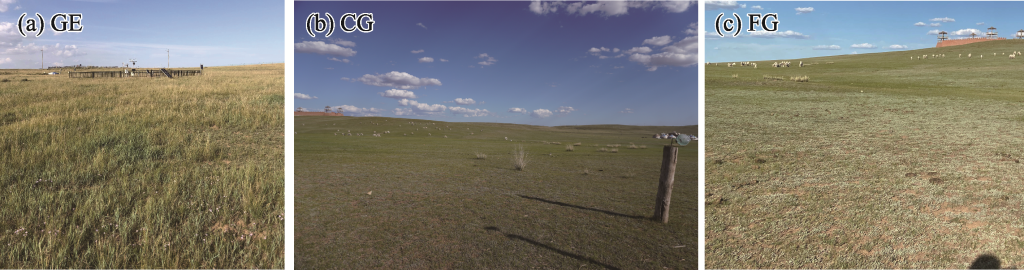
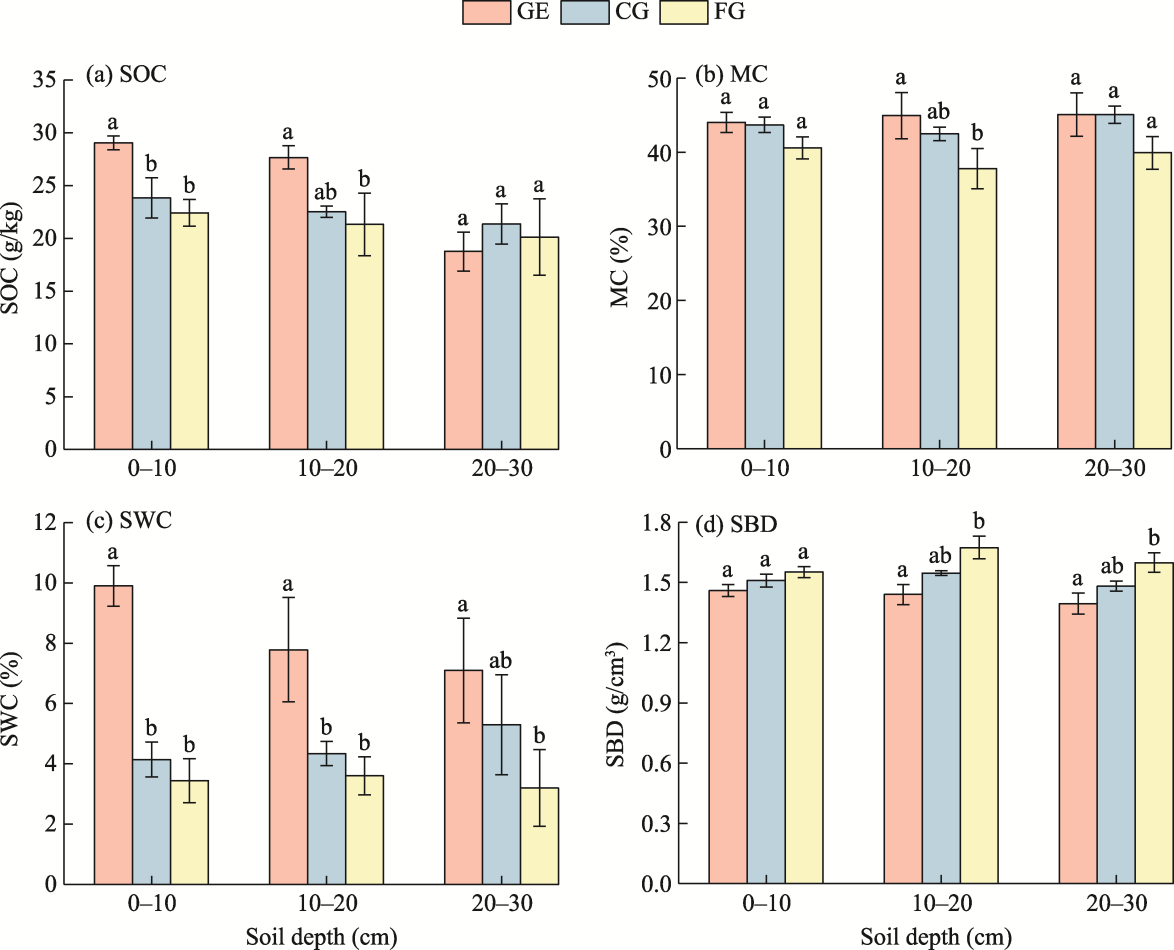
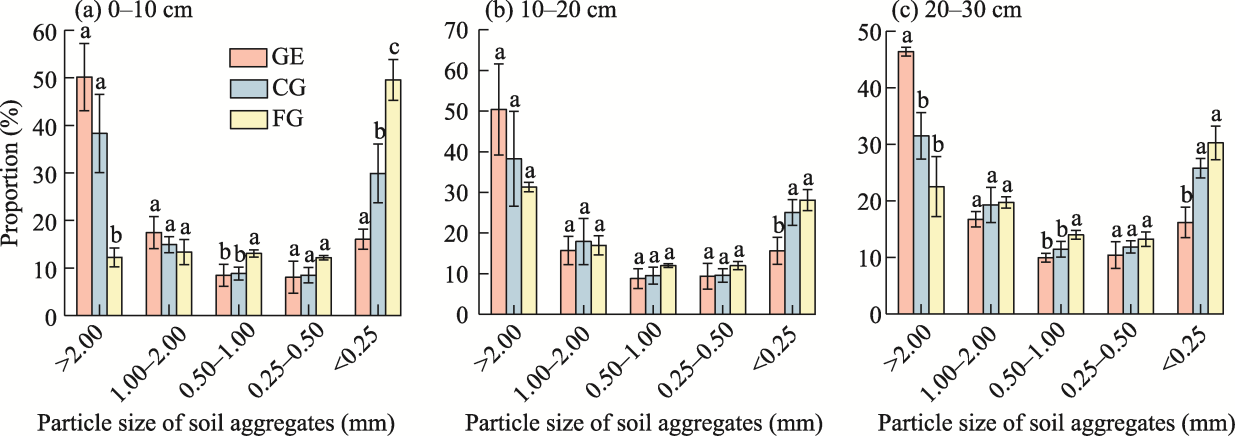
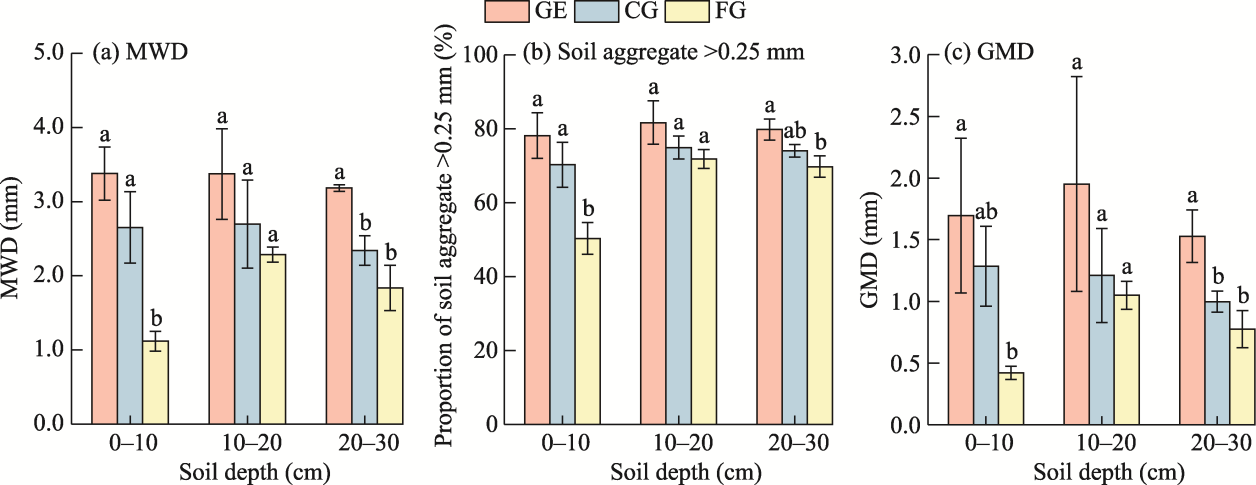
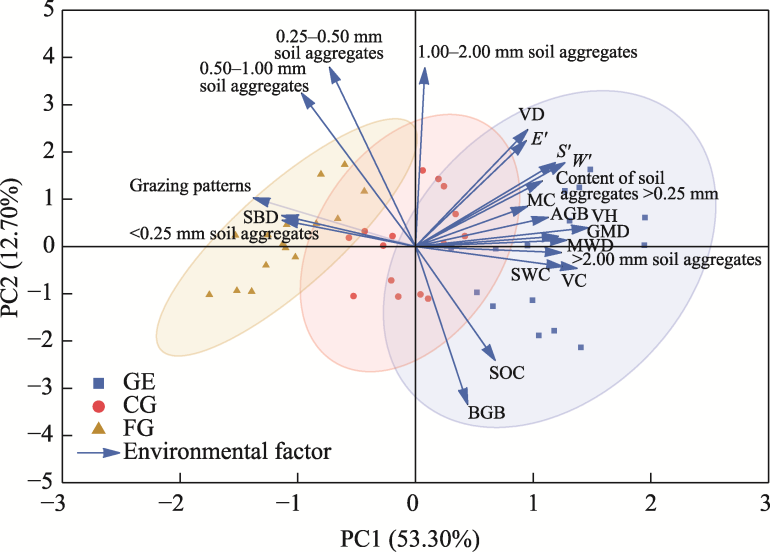
Abstract Global grassland degradation necessitates the identification of sustainable grazing management strategies. In semi-arid regions, grazing exclusion (GE), cold-season grazing (CG), and free grazing (FG) represent common practices in grassland ecosystems, yet the long-term ecological consequences of these patterns on plant community structure and soil aggregate stability remain inadequately elucidated. In this study, we evaluated the effects of GE, CG, and FG on soil organic carbon, soil water content, soil bulk density, soil aggregates, and vegetation indicators in Xilamuren steppe, a semi-arid grassland in northern China through field sampling and laboratory analyses in 2024. Our findings revealed that, compared to CG and FG, GE significantly enhanced aboveground and belowground biomass, species diversity, and soil physical-chemical properties in the 0-30 cm layer. The dominant plant species in GE and CG sites were Stipa krylovii, Leymus chinensis, and Agropyron cristatum, whereas Stipa krylovii, Artemisia frigida, and Leymus chinensis were predominant in FG site. Different grazing patterns led to distinct soil aggregate distributions, with >2.00 and <0.25 mm aggregates exhibiting the highest content in different soil layers depending on the grazing patterns. All grazing management strategies significantly improved soil aggregate stability, with the overall stability following the order: GE>CG>FG. Furthermore, random forest modeling identified plant species diversity, plant growth traits, and grazing patterns as the primary determinants of soil aggregate stability. Collectively, these results offer valuable insights into the sustainable management and ecological restoration of semi-arid grasslands under different grazing pressures.
|
|
Received: 01 July 2025
Published: 28 February 2026
|
|
Corresponding Authors:
*GE Rile (E-mail: gerile197081@126.com)
|
| About author: First author contact: The first and second authors contributed equally to this work. |
|
|
| [1] |
Alaoui A, Lipiec J, Gerke H H. 2011. A review of the changes in the soil pore system due to soil deformation: A hydrodynamic perspective. Soil and Tillage Research, 115-116: 1-15.
doi: 10.1016/j.still.2011.06.002
|
|
|
| [2] |
Arévalo J R, González-Montelongo C, Encina-Domínguez J A, et al. 2022. Changes in richness and species composition after five years of grazing exclusion in an endemic pasture of northern Mexico. Land, 11(11): 1962, doi: 10.3390/land11111962.
|
|
|
| [3] |
Baumert V L, Vasilyeva N A, Vladimirov A A, et al. 2018. Root exudates induce soil macroaggregation facilitated by fungi in subsoil. Frontiers in Environmental Science, 6: 140, doi: 10.3389/fenvs.2018.00140.
|
|
|
| [4] |
Dai L C, Guo X W, Ke X, et al. 2019. Moderate grazing promotes the root biomass in Kobresia meadow on the northern Qinghai-Tibet Plateau. Ecology and Evolution, 9(16): 9395-9406.
doi: 10.1002/ece3.v9.16
|
|
|
| [5] |
Du Z, Zhou R, Chen Y, et al. 2025. Effects of long-term vegetation restoration on soil aggregate and aggregate-associated nutrient stoichiometry of desertified grassland on the eastern Qinghai-Tibet Plateau. Agriculture, Ecosystems & Environment, 388: 109661, doi: 10.1016/j.agee.2025.109661.
|
|
|
| [6] |
Fan J L, Jin H, Zhang C H, et al. 2021. Grazing intensity induced alternations of soil microbial community composition in aggregates drive soil organic carbon turnover in a desert steppe. Agriculture, Ecosystems & Environment, 313: 107387, doi: 10.1016/j.agee.2021.107387.
|
|
|
| [7] |
Gao S, Hong Y, Tuya W L, et al. 2024. Response of species diversity and stability of typical steppe plant communities on the Mongolian Plateau to different grazing patterns. Ecology and Evolution, 14(10): e70360, doi: 10.1002/ece3.70360.
|
|
|
| [8] |
Garcia L, Damour G, Gary C, et al. 2019. Trait-based approach for agroecology: contribution of service crop root traits to explain soil aggregate stability in vineyards. Plant and Soil, 435(1-2): 1-14.
doi: 10.1007/s11104-018-3874-4
|
|
|
| [9] |
González-Rosado M, Parras-Alcántara L, Aguilera-Huertas J, et al. 2020. Effects of land management change on soil aggregates and organic carbon in Mediterranean olive groves. CATENA, 195: 104840, doi: 10.1016/j.catena.2020.104840.
|
|
|
| [10] |
He G X, Liu X N, Li Y L, et al. 2025. Response of plant life forms and soil physical properties to near-natural restoration measures in alpine grassland, Tibetan Plateau. Frontiers in Plant Science, 15: 1504754, doi: 10.3389/fpls.2024.1504754.
|
|
|
| [11] |
Ju W L, Fang L C, Shen G T, et al. 2023. New perspectives on microbiome and nutrient sequestration in soil aggregates during long-term grazing exclusion. Global Change Biology, 30(1): e17027, doi: 10.1111/gcb.17027.
|
|
|
| [12] |
Klaus V H, Schäfer D, Prati D, et al. 2018. Effects of mowing, grazing and fertilization on soil seed banks in temperate grasslands in Central Europe. Agriculture, Ecosystems & Environment, 256: 211-217.
doi: 10.1016/j.agee.2017.11.008
|
|
|
| [13] |
Kölbl A, Steffens M, Wiesmeier M, et al. 2011. Grazing changes topography-controlled topsoil properties and their interaction on different spatial scales in a semi-arid grassland of Inner Mongolia, P.R. China. Plant and Soil, 340: 35-58.
doi: 10.1007/s11104-010-0473-4
|
|
|
| [14] |
Lewińska K E, Ives A R, Morrow C J, et al. 2023. Beyond ''greening'' and ''browning'': Trends in grassland ground cover fractions across Eurasia that account for spatial and temporal autocorrelation. Global Change Biology, 29(16): 4620-4637.
doi: 10.1111/gcb.v29.16
|
|
|
| [15] |
Li H, Yang Z Y, Guo X, et al. 2025. Responses of soil aggregate characteristics to grazing intensity differ between topsoil and subsoil in a typical steppe. Frontiers in Environmental Science, 13: 1610919, doi: 10.3389/fenvs.2025.1610919.
|
|
|
| [16] |
Li H N, Dang X H, Han Y L, et al. 2023. Sand-fixing measures improve soil particle distribution and promote soil nutrient accumulation for desert-Yellow River coastal ecotone, China. Ecological Indicators, 157: 111239, doi: 10.1016/j.ecolind.2023.111239.
|
|
|
| [17] |
Liu D D, Ju W L, Jin X L, et al. 2021. Associated soil aggregate nutrients and controlling factors on aggregate stability in semiarid grassland under different grazing prohibition timeframes. Science of The Total Environment, 777: 146104, doi: 10.1016/j.scitotenv.2021.146104.
|
|
|
| [18] |
Liu J K, Bian Z, Zhang K B, et al. 2019a. Effects of different fencing regimes on community structure of degraded desert grasslands on Mu Us Desert, China. Ecology and Evolution, 9(6): 3367-3377.
doi: 10.1002/ece3.2019.9.issue-6
|
|
|
| [19] |
Liu Y Y, Zhang Z Y, Tong L J, et al. 2019b. Assessing the effects of climate variation and human activities on grassland degradation and restoration across the globe. Ecological Indicators, 106: 105504, doi: 10.1016/j.ecolind.2019.105504.
|
|
|
| [20] |
Liu Z Y, Baoyin T, Duan J J, et al. 2018. Nutrient characteristics in relation to plant size of a perennial grass under grazing exclusion in degraded grassland. Frontiers in Plant Science, 9: 295, doi: 10.3389/fpls.2018.00295.
pmid: 29593759
|
|
|
| [21] |
Mi W T, Ren W B, Chi Y, et al. 2024. Heavy grazing reduces the potential for grassland restoration: a global meta-analysis. Environmental Research Letters, 19: 103001, doi: 10.1088/1748-9326/ad703f.
|
|
|
| [22] |
Özüdoğru Ö, Özüdoğru B, Tavşanoğlu Ç. 2021. Recovery of a plant community in the central Anatolian steppe after small-scale disturbances. Folia Geobotanica, 56: 241-254.
doi: 10.1007/s12224-021-09404-9
|
|
|
| [23] |
Pulido M, Schnabel S, Lavado Contador J F, et al. 2017. Reduction of the frequency of herbaceous roots as an effect of soil compaction induced by heavy grazing in rangelands of SW Spain. CATENA, 158: 381-389.
doi: 10.1016/j.catena.2017.07.019
|
|
|
| [24] |
Ribeiro I, Domingos T, McCracken D, et al. 2023. The use of domestic herbivores for ecosystem management in Mediterranean landscapes. Global Ecology and Conservation, 46: e02577, doi: 10.1016/j.gecco.2023.e02577.
|
|
|
| [25] |
Roberts A J, Johnson N C. 2021. Effects of mob-grazing on soil and range quality vary with plant species and season in a semiarid grassland. Rangeland Ecology & Management, 79: 139-149.
doi: 10.1016/j.rama.2021.04.008
|
|
|
| [26] |
Romero-Ruiz A, Monaghan R, Milne A, et al. 2023. Modelling changes in soil structure caused by livestock treading. Geoderma, 431: 116331, doi: 10.1016/j.geoderma.2023.116331.
|
|
|
| [27] |
Santiago T, Pablo L P, Olga S C, et al. 2021. Soil microbial communities respond to an environmental gradient of grazing intensity in south Patagonia Argentina. Journal of Arid Environments, 184: 104300, doi: 10.1016/j.jaridenv.2020.104300.
|
|
|
| [28] |
Schönbach P, Wan H W, Gierus M, et al. 2011. Grassland responses to grazing: effects of grazing intensity and management system in an Inner Mongolian steppe ecosystem. Plant and Soil, 340(1): 103-115.
doi: 10.1007/s11104-010-0366-6
|
|
|
| [29] |
Søndergaard S A, Ejrnæs R, Svenning J C, et al. 2025. From grasslands to forblands: Year-round grazing as a driver of plant diversity. Journal of Applied Ecology, 62(5): 1104-1113.
doi: 10.1111/jpe.v62.5
|
|
|
| [30] |
Song S S, Zhu J L, Zheng T L, et al. 2020. Long-term grazing exclusion reduces species diversity but increases community heterogeneity in an alpine grassland. Frontiers in Ecology and Evolution, 8: 66, doi: 10.3389/fevo.2020.00066.
|
|
|
| [31] |
Stavi I, Ungar E D, Lavee H, et al. 2011. Soil aggregate fraction 1-5 mm: An indicator for soil quality in rangelands. Journal of Arid Environments, 75(11): 1050-1055.
doi: 10.1016/j.jaridenv.2011.04.035
|
|
|
| [32] |
Sun D, Yang H, Guan D X, et al. 2018. The effects of land use change on soil infiltration capacity in China: A meta-analysis. Science of The Total Environment, 626: 1394-1401.
doi: 10.1016/j.scitotenv.2018.01.104
|
|
|
| [33] |
Sun H, Zhao Y G, Gao L Q, et al. 2024. Reasonable grazing may balance the conflict between grassland utilization and soil conservation in the semi-arid hilly areas, China. Journal of Arid Land, 16(8): 1130-1146.
doi: 10.1007/s40333-024-0025-z
|
|
|
| [34] |
Tang P C, Guo J Y, Gao X Y, et al. 2024. Variation and transformation of evapotranspiration at different scales in a desert steppe. Water, 16(2): 288, doi: 10.3390/w16020288.
|
|
|
| [35] |
Vogelmann E S, Reichert J M, Prevedello J, et al. 2017. Soil moisture influences sorptivity and water repellency of topsoil aggregates in native grasslands. Geoderma, 305: 374-381.
doi: 10.1016/j.geoderma.2017.06.024
|
|
|
| [36] |
Wan L F, Liu G H, Sun J, et al. 2024. Optimizing grazing exclusion duration for carbon sequestration in grasslands: Incorporating temporal heterogeneity of aboveground biomass and soil organic carbon. Science of The Total Environment, 927: 172006, doi: 10.1016/j.scitotenv.2024.172006.
|
|
|
| [37] |
Wang T W, Zhang Z, Li Z B, et al. 2017. Grazing management affects plant diversity and soil properties in a temperate steppe in northern China. CATENA, 158: 141-147.
doi: 10.1016/j.catena.2017.06.020
|
|
|
| [38] |
Warren S D, Nevill M B, Blackburn W H, et al. 1986. Soil response to trampling under intensive rotation grazing. Soil Science Society of America Journal, 50(5): 1336-1341.
doi: 10.2136/sssaj1986.03615995005000050050x
|
|
|
| [39] |
Wei W R, Zhen Q Y, Deng J, et al. 2022. Grazing during the grassland greenup period promotes plant species richness in alpine grassland in winter pastures. Frontiers in Plant Science, 13: 973662, doi: 10.3389/fpls.2022.973662.
|
|
|
| [40] |
Wu B H, Li X, Lin S K, et al. 2024. Miscanthus sp. root exudate alters rhizosphere microbial community to drive soil aggregation for heavy metal immobilization. Science of The Total Environment, 949: 175009, doi: 10.1016/j.scitotenv.2024.175009.
|
|
|
| [41] |
Wu X L, Dang X H, Meng Z J, et al. 2022. Mechanisms of grazing management impact on preferential water flow and infiltration patterns in a semi-arid grassland in northern China. Science of The Total Environment, 813: 152082, doi: 10.1016/j.scitotenv.2021.152082.
|
|
|
| [42] |
Xu G J, Kang X M, Li W, et al. 2022. Different grassland managements significantly change carbon fluxes in an alpine meadow. Frontiers in Plant Science, 13: 1000558, doi: 10.3389/fpls.2022.1000558.
|
|
|
| [43] |
Xun W B, Yan R R, Ren Y, et al. 2018. Grazing-induced microbiome alterations drive soil organic carbon turnover and productivity in meadow steppe. Microbiome, 6: 170, doi: 10.1186/s40168-018-0544-y.
pmid: 30236158
|
|
|
| [44] |
Yang P N, Li X L, Li C Y, et al. 2023. Effects of long-term exclosure on main plant functional groups and their biochemical properties in a patchily degraded alpine meadow in the source zone of the Yellow River, West China. Agronomy, 13(11): 2781, doi: 10.3390/agronomy13112781.
|
|
|
| [45] |
Yang Q S, Peng J, Ni S M, et al. 2024. Soil erosion-induced decline in aggregate stability and soil organic carbon reduces aggregate-associated microbial diversity and multifunctionality of agricultural slope in the Mollisol region. Land Degradation & Development, 35(11): 3714-3726.
doi: 10.1002/ldr.v35.11
|
|
|
| [46] |
Yang Y, Meng Z J, Li H N, et al. 2025. Soil porosity as a key factor of soil aggregate stability: insights from restricted grazing. Frontiers in Environmental Science, 12: 1535193, doi: 10.3389/fenvs.2024.1535193.
|
|
|
| [47] |
Yu R P, Zhang W P, Yu Y C, et al. 2020. Linking shifts in species composition induced by grazing with root traits for phosphorus acquisition in a typical steppe in Inner Mongolia. Science of The Total Environment, 712: 136495, doi: 10.1016/j.scitotenv.2020.136495.
|
|
|
| [48] |
Zhang J M, Chi F Q, Wei D, et al. 2019. Impacts of long-term fertilization on the molecular structure of humic acid and organic carbon content in soil aggregates in black soil. Scientific Reports, 9: 11908, doi: 10.1038/s41598-019-48406-8.
pmid: 31417124
|
|
|
| [49] |
Zhang X R, Zhang W Q, Sai X Y L T, et al. 2022. Grazing altered soil aggregates, nutrients and enzyme activities in a Stipa kirschnii steppe of Inner Mongolia. Soil and Tillage Research, 219: 105327, doi: 10.1016/j.still.2022.105327.
|
|
|
| [50] |
Zhang Y W, Peng Z C, Wang Z F, et al. 2025. Plant community-dominating species can sustain population biomass by modifying and strengthening their own growth traits to deal with long-term grazing. Agriculture, Ecosystems & Environment, 391: 109744, doi: 10.1016/j.agee.2025.109744.
|
|
|
| [51] |
Zhang Y Y, Zhao W Z, Li X B, et al. 2021. Contribution of soil macropores to water infiltration across different land use types in a desert-oasis ecoregion. Land Degradation & Development, 32: 1751-1760.
doi: 10.1002/ldr.v32.4
|
|
|
| [52] |
Zhao Y, Peth S, Horn R, et al. 2010. Modeling grazing effects on coupled water and heat fluxes in Inner Mongolia grassland. Soil and Tillage Research, 109(2): 75-86.
doi: 10.1016/j.still.2010.04.005
|
|
|
| [53] |
Zhou Y, Ma H B, Xie Y Z, et al. 2022. Response of soil aggregate stability and erodibility to different treatments on typical steppe in the Loess Plateau, China. Restoration Ecology, 30(5): e13593, doi: 10.1111/rec.13593.
|
|
|
| [54] |
Zhu G Q, Yuan C X, Gong H D, et al. 2021. Effects of short-term grazing prohibition on soil physical and chemical properties of meadows in Southwest China. PeerJ, 9: e11598, doi: 10.7717/peerj.11598.
|
|
|
| [55] |
Zweigel R B, Dashtseren A, Temuujin K, et al. 2024. Impact of livestock activity on near-surface ground temperatures in central Mongolian grasslands. Biogeosciences, 21(22): 5059-5077.
doi: 10.5194/bg-21-5059-2024
|
|
|
|
Viewed |
|
|
|
Full text
|
|
|
|
|
Abstract
|
|
|
|
|
Cited |
|
|
|
|
| |
Shared |
|
|
|
|
| |
Discussed |
|
|
|
|